
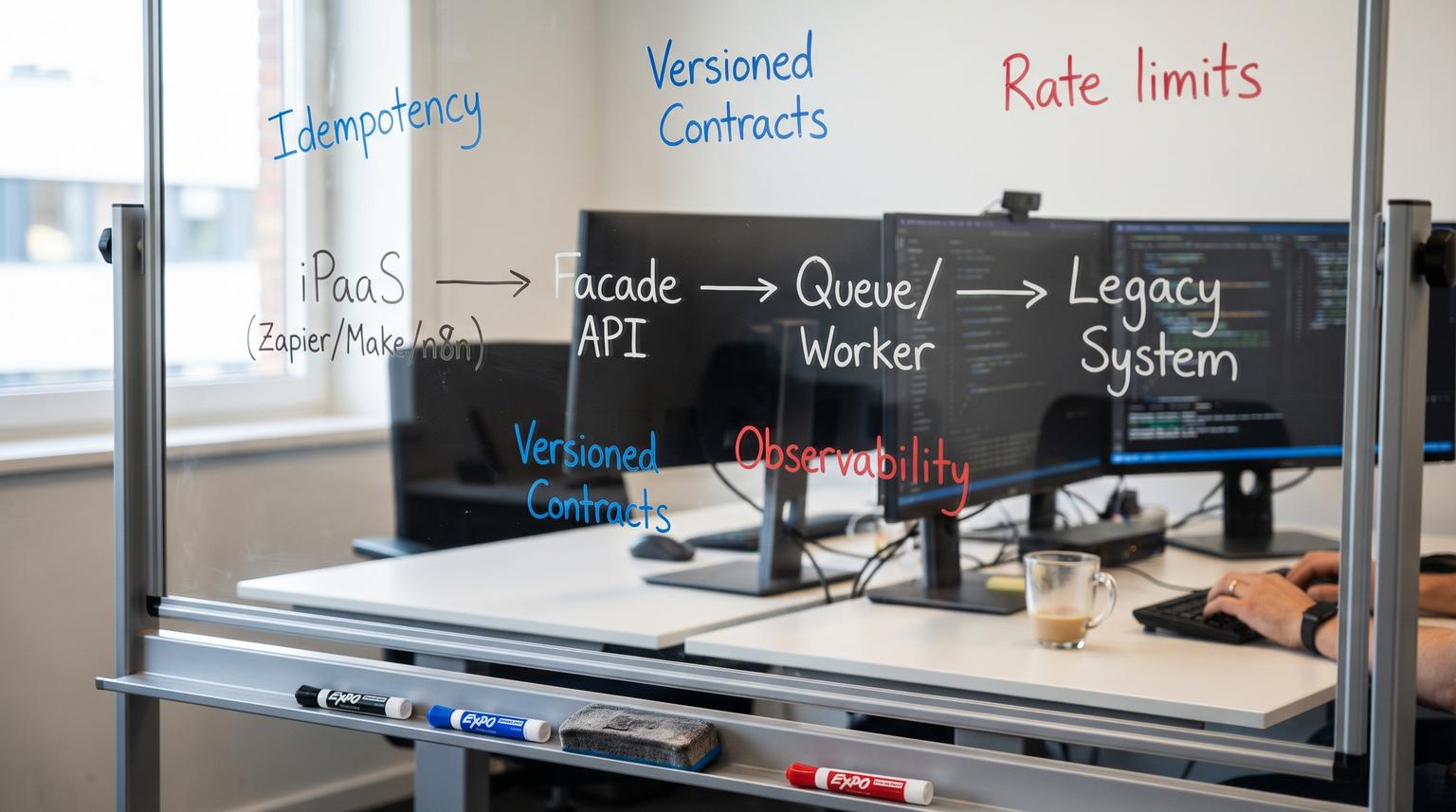
Ops and revenue teams love the speed of iPaaS tools like n8n, Zapier and Make until a legacy or in-house system becomes the bottleneck. The hard part is not building the first workflow. It is keeping workflows reliable when volumes spike, schemas drift and retries create duplicates. This is where custom API development can act as a thin facade that makes a brittle system safe for automation without creating a new long-term maintenance burden.
This article gives a practical decision approach with explicit thresholds, a scored matrix you can reuse and a reference architecture for a stable API layer that iPaaS tools can consume safely. It ends with a scoped rollout plan and a cost and ownership model you can defend to finance and leadership.
Quick summary:
- Use iPaaS connectors when volume is modest, failure impact is low and the upstream system changes rarely.
- Introduce a thin API facade when you need predictable reliability, auditability and stable contracts for multiple workflows.
- Hybrid is common: iPaaS at the edge for orchestration and a small internal API for normalization, throttling and safety.
- Your facade must be designed for automation realities: idempotency, retries, versioning and observability.
Quick start
- Score your integration using the matrix below for volume, SLA impact, security and change rate.
- If any single category scores a 4 or 5, plan a thin API facade for that workflow path.
- Define the minimum stable endpoints and data contracts your automations need and freeze them behind a version.
- Add idempotency keys, async acceptance for bursts and centralized logging with correlation IDs.
- Run an MVP in parallel with existing automations, then harden with monitoring, retries and runbooks.
In most teams, iPaaS connectors are best for low-risk workflows where occasional delays or manual replays are acceptable. Build a thin custom API facade when the workflow is core revenue or operationally critical, when data volume triggers throttling, when compliance requires strict control of data handling or when the underlying system changes often. The facade reduces maintenance debt by centralizing stability features so you do not rebuild reliability logic across dozens of workflows.
Why connector-first integrations create maintenance debt in legacy and in-house systems
Most maintenance debt shows up as repeated small fixes: a field rename breaks a mapping, a status code changes meaning, a trigger sends duplicates or an integration silently delays during bursts. Each fix looks small, but the total cost is high because the same problems reappear in many workflows and across multiple iPaaS scenarios.
Three patterns we see repeatedly when teams connect directly to a legacy app or internal database:
- Rate limits and burst behavior leak into every workflow. Tools can throttle or delay processing under load. Zapier webhooks can be throttled and return 429 errors and in some cases a request may be accepted but processing may be delayed, which breaks assumptions about immediate downstream effects. See Zapier webhook rate limits. Make has similar realities around 429s, scheduling modes and reruns, which often leads to scattered delays and sequential processing settings across scenarios. See Make rate limit errors.
- Schema drift breaks mappings. An internal system changes a field, a meaning or a validation rule. When each automation talks directly to the system, you now have many breakpoints. When the contract is centralized behind a facade, you can adapt once.
- Failures are hard to detect fast. You may have partial failure where one step fails but upstream systems already changed. Without consistent correlation IDs, structured errors and alerting you find out from a customer or finance reconciliation. n8n has a strong pattern here with a centralized error workflow and structured failure payloads. See n8n error handling.
A thin facade is essentially an anti-corruption layer: it translates, normalizes and protects both sides so automation tools do not inherit legacy quirks. This is a well-known pattern for decoupling semantics and release timelines and it applies cleanly to iPaaS consumers. See anti-corruption layer guidance. For a deeper reliability-focused methodology (OAuth/token refresh, idempotency, retries, DLQs, monitoring), use our pillar guide: API Integration Engineering Playbook for reliable API and webhook connections.
A scored decision matrix with thresholds you can defend
Use this matrix to decide whether to stay connector-first, go hybrid or invest in a facade API. Score each dimension 1 to 5 based on your current needs, not best-case hopes. Then total the score and apply the recommendation.

| Dimension | 1 (Connector-friendly) | 3 (Hybrid zone) | 5 (Facade strongly recommended) | Your score (1-5) |
|---|---|---|---|---|
| Data volume and burstiness | < 500 events/day, bursts < 10/min, manual replay acceptable | 500 to 10k/day or bursts 10 to 100/min, occasional throttling observed | > 10k/day or bursts > 100/min, 429s or queue delays impact ops | |
| SLA and business impact | Delays of hours are fine, failures do not block revenue or fulfillment | Needs same-day reliability, failures require timely human intervention | Near-real-time or strict deadlines, failures cause lost revenue, chargebacks or compliance risk | |
| Security and compliance constraints | Non-sensitive data, basic auth acceptable, no audit requirements | PII present, needs scoped access, basic audit logs required | Regulated data, strict least-privilege, token rotation, full auditability and data minimization required | |
| Underlying system change rate | Changes quarterly or less, stable fields and semantics | Changes monthly, occasional breaking changes or new validations | Changes weekly, schema and semantics shift often or team boundaries are misaligned |
How to interpret your total score
- 4 to 7: Prefer iPaaS connectors. Add light governance: naming, error alerts and a simple retry policy.
- 8 to 13: Hybrid is usually best. Keep iPaaS for orchestration but introduce a small facade for the risky operations.
- 14 to 20: Build the facade. Connector-first will likely turn into constant breakage and hidden operational cost.
A simple decision rule that prevents regret
If any single dimension scores a 4 or 5, treat that workflow path as a candidate for a facade even if the total score is moderate. One high-risk factor like compliance or high-volume bursts can overwhelm the perceived speed advantage of connecting directly.
What the thin facade API should do and what it should not do
The goal is not to rebuild your internal system. The goal is to create a stable boundary that is easy for automation tools to call safely. Think of it as a product for internal consumers.
Do
- Normalize contracts. Provide stable resource names and field meanings even if the legacy side is inconsistent.
- Centralize throttling and backpressure. Accept bursts quickly then process in a controlled way so you do not scatter delays and rate caps across many workflows.
- Provide safe retries. Assume iPaaS will retry, rerun or deliver duplicates. Build idempotency into write operations. If duplicates are already a pain point, see how idempotent upserts stop duplicate writes in webhook-to-CRM flows.
- Expose observability. Make it easy to trace a failed workflow from iPaaS execution to API request to legacy side effect.
Do not
- Do not mirror the entire legacy schema. That locks you into legacy decisions and increases blast radius when it changes.
- Do not encode complex orchestration. Keep orchestration in n8n, Zapier or Make where business users can iterate. Keep the facade focused on stable primitives.
- Do not skip operational ownership. A facade without monitoring becomes a new single point of failure.
Reference architecture for a safe iPaaS-consumable API facade
This is the target shape we recommend when a legacy or in-house system must be exposed reliably to automation tools. It borrows the anti-corruption layer idea: translate and protect, then keep both sides loosely coupled.
- iPaaS layer (n8n, Zapier, Make): Triggers, routing, enrichment, notifications, human-in-the-loop approvals.
- Facade API: A small service that exposes stable endpoints and normalizes data. It handles auth, validation, idempotency and standardized errors.
- Queue and worker (optional but common): For burst control, long-running jobs and exactly-once style processing semantics.
- Legacy adapter: The code that actually talks to the old database, SOAP service, file drop, RPA bot or monolith endpoints.
- Observability stack: Centralized logs, metrics, traces and alerting tied to correlation IDs from iPaaS executions.

Recommended request flow
- iPaaS calls
POST /v1/orderswith anIdempotency-Keyheader and aX-Correlation-Idit generates per workflow execution. - Facade validates, writes an intent record and responds quickly with
202 Acceptedand ajob_id. - Worker processes the job with controlled concurrency and calls the legacy adapter.
- Facade exposes
GET /v1/jobs/{job_id}for status and optionally emits a webhook back to the iPaaS when complete.
Minimal endpoint set that covers most automation needs
POST /v1/{resource}create intent (async), idempotentPATCH /v1/{resource}/{id}update (idempotent where possible)GET /v1/{resource}/{id}read for verificationPOST /v1/{resource}:batchbulk create or update to reduce API callsGET /v1/jobs/{job_id}job status for async flows
What good API hardening looks like for automation workloads
This is where many teams underbuild. They ship endpoints that work in Postman but fail under real workflow behavior like retries, reruns, parallel executions and partial failures.
Stable contracts and versioning
- Use explicit versions like
/v1/and do not introduce breaking changes without a new version. - Document required fields, optional fields and invariants. Treat field meaning as part of the contract, not just field names.
- Normalize legacy oddities. If the legacy system uses many status values, map them to a smaller stable set for automation consumers.
Idempotency and safe retries
- Require an
Idempotency-Keyon create and side-effect endpoints. Store the key with request hash and outcome. - Return the same result for the same key to make iPaaS reruns safe.
- Handle out-of-order delivery by using monotonic event timestamps or sequence numbers when applicable.
Backpressure, rate limiting and burst control
- Prefer
202 Acceptedfor heavy operations and process asynchronously. This prevents workflow timeouts and absorbs bursts. - Implement concurrency caps per tenant or per integration and return
429withRetry-Afterwhen needed. - Offer batch endpoints to reduce call counts for bulk updates and nightly syncs.
Observability that prevents silent breakage
- Log
X-Correlation-Id, idempotency key, resource IDs and legacy transaction identifiers. - Emit metrics: request count, error rates by endpoint, queue depth, processing latency, retry count.
- Connect iPaaS failure signals into a single alerting channel. In n8n a shared error workflow makes this reliable. The error payload includes fields like execution id, retryOf and lastNodeExecuted, which is ideal for correlation.
Real-world insight: the fastest way to reduce MTTR is to make sure your facade returns a single stable error shape with an internal error code. Many legacy systems return non-standard errors or even HTML. When your API normalizes errors the iPaaS can route failures consistently and your team can build runbooks that actually match what happens in production.
Common failure pattern when teams skip the facade
A frequent mistake is building dozens of connector-level workarounds for the same legacy constraint: every workflow includes its own delay nodes, its own dedupe logic and its own interpretation of legacy statuses. Six months later nobody can predict what happens when you rerun a failed scenario because each one behaves differently. The result is connector sprawl and a growing support burden.
A thin facade prevents this by centralizing the hard parts: dedupe, throttling, contract stability and traceability. The iPaaS stays focused on orchestration where it shines.
MVP to hardened v1 rollout plan with ownership and rollback
This rollout pattern keeps risk low while producing a stable integration layer you can expand over time.
Phase 0: Scope and success criteria (1 week)
- Pick one high-value workflow path, not every integration at once.
- Define success: acceptable delay, error budget, maximum manual interventions per week and audit needs.
- Decide ownership: who is on-call for the facade and who owns the iPaaS workflows.
Phase 1: MVP facade (2 to 4 weeks)
- Implement 2 to 4 endpoints that cover the chosen workflow.
- Add auth, request validation, idempotency keys and correlation IDs from day one.
- Return 202 for heavy operations and add
GET /jobsstatus. - Wire iPaaS error handling to alerts. In n8n, create a shared error workflow and test it by intentionally failing a run. You can use a Stop And Error node to verify the entire path end-to-end.
Phase 2: Parallel run and cutover (1 to 2 weeks)
- Run the new path in shadow mode where feasible: call the facade and compare outcomes without changing production state.
- Cut over a limited segment (one team, one region or one pipeline) and measure failure rates and processing times.
- Rollback plan: keep the old connector path available for a defined period and ensure you can replay failed jobs safely via idempotency.
Phase 3: Hardened v1 (ongoing)
- Add rate limiting policies and concurrency control that match real load.
- Add dashboards and alerts for queue depth, retries and SLA thresholds.
- Add contract tests so legacy changes do not break automations silently.
- Expand endpoints only when you have at least one stable consumer and clear ownership.
Cost and ownership model for a defensible build vs buy decision
The cost question is rarely just subscription vs engineering. It is about who pays for failures and how often. A practical ownership model usually includes:
- Build cost: initial engineering plus security review and CI/CD setup.
- Run cost: hosting, logs, on-call time and incident response.
- Change cost: how many workflows must be updated when the legacy system changes.
- Failure cost: lost revenue, delayed invoicing, support tickets, refunds and reconciliation time.
Connector-only approaches often look cheaper until change and failure costs accumulate across many workflows. A thin facade typically becomes economically favorable when it reduces repeated connector maintenance and shortens incident resolution time.
When this approach is not the best fit: if your workflow is truly temporary, low volume and non-critical or if the system you are integrating already has a stable well-supported API with clear contracts and predictable rate limits then adding a facade may be unnecessary overhead. If your bottleneck is an older interface (SOAP exports, CSV drops), this practical guide may help: build a REST wrapper n8n and Zapier can trust.
Primary CTA: If you want help scoring your specific legacy or in-house integration and outlining a thin facade that plays nicely with n8n, we can review your current workflows and propose a scoped MVP. Book a consultation.
FAQ
Common follow-ups we hear from ops and revenue teams when planning an integration layer for automation tools.
Do we need a facade API if we already use n8n, Zapier or Make?
Not always. If volumes are low, failures are non-critical and the upstream system changes rarely then direct connectors are usually enough. A facade becomes valuable when you need stable contracts, safe retries, better auditability or burst control across many workflows.
What is the minimum set of features a thin facade should include?
At minimum: stable versioned endpoints, request validation, idempotency for write operations, normalized error responses, correlation IDs for tracing and basic metrics and logs. If you expect bursts or long-running operations add async job handling with 202 Accepted and a job status endpoint.
How do we prevent duplicate records when iPaaS retries or reruns?
Make create and side-effect operations idempotent by requiring an Idempotency-Key and storing the outcome for that key. On retry, return the same result rather than performing the action again. Also design for out-of-order events by using timestamps or sequence rules where applicable.
Should the facade be synchronous or asynchronous?
Use synchronous responses for lightweight reads and fast writes that complete quickly. Use asynchronous patterns when the legacy system is slow, when you need burst protection or when timeouts and retries are likely. In async mode respond quickly with 202 Accepted and provide a job status endpoint or callback mechanism.
How do we keep the facade from becoming another system nobody wants to own?
Keep the scope small, limit endpoints to what workflows actually need and assign clear ownership for on-call and releases. Add dashboards and alerting early and write a short runbook for common failure modes. A thin layer with strong observability is easier to own than dozens of fragile workflows.
