
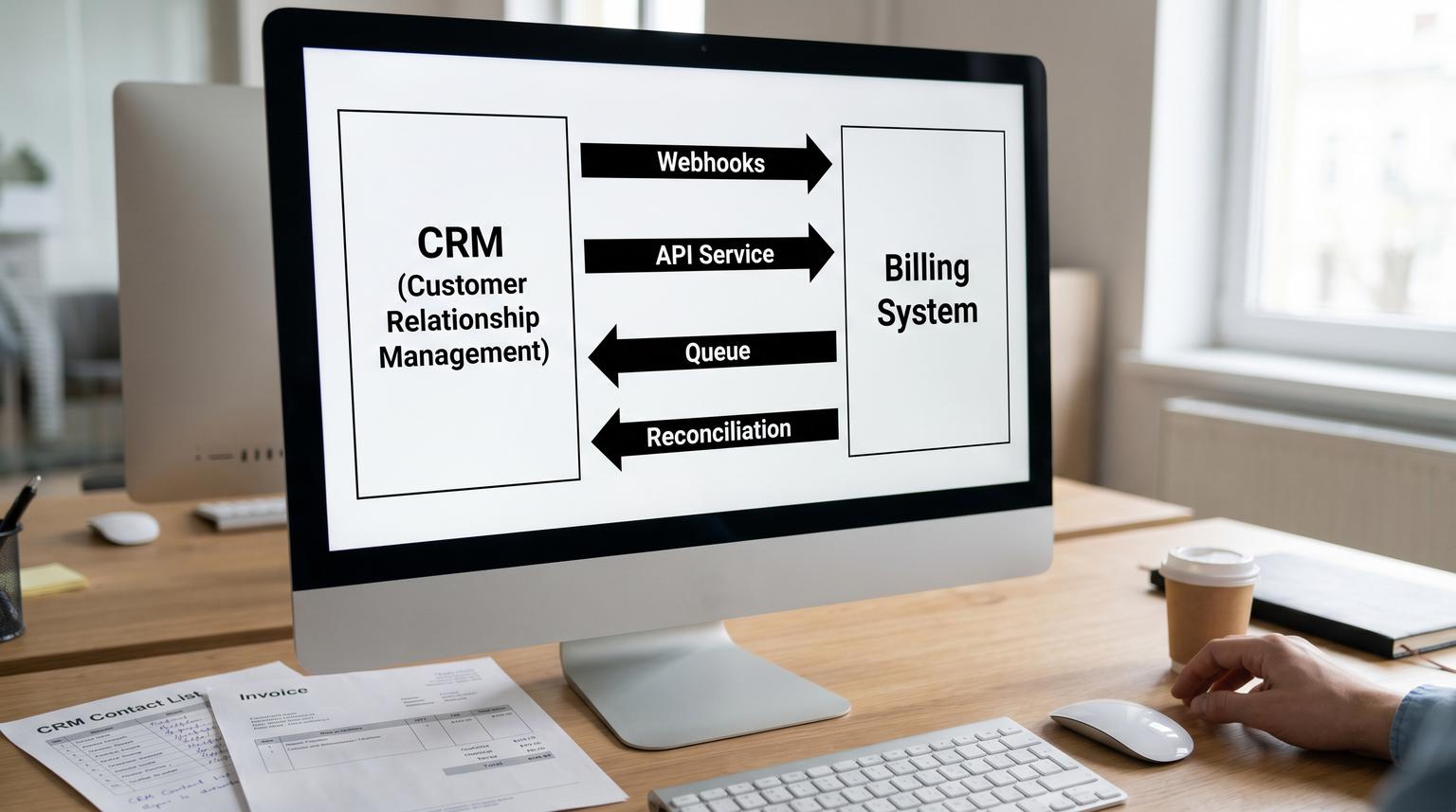
Bi-directional CRM and billing sync sounds simple until it is not. The moment you sync customers, subscriptions and invoices both ways you inherit retries, duplicates, out-of-order updates and conflicting edits. This is where teams discover that a custom API integration for business is sometimes the safer option even if an iPaaS like Zapier, Make or n8n can connect the apps quickly. This article is for RevOps, ops managers and tech-savvy founders who need accurate customer state across systems without "mostly synced" data.
At a glance:
- Bi-directional CRM ↔ billing is a state synchronization problem, not a field mapping problem.
- If you cannot guarantee idempotency, replay safety and conflict rules you will eventually get duplicates or stale lifecycle stages.
- iPaaS works best when ownership is simple and errors can be triaged without strict SLAs.
- Custom code wins when you need deterministic retries, auditability and long-term governance over changes.
Quick start
- List the objects and writes you want both systems to perform (customer, subscription, invoice, credit note, lifecycle stage).
- Assign system-of-record per object or per field and write down the conflict rule (who wins and when).
- Decide your reliability minimums: idempotent creates, replay and dedupe, rate-limit backoff, monitoring and an operator runbook.
- Score iPaaS vs custom against the decision matrix below using your real constraints (SLA, change frequency, volume and compliance).
- Pick an architecture pattern (one-way enrichment, near-real-time bi-directional or migration with a temporary source of truth).
If your CRM ↔ billing sync must be correct under retries, rate limits and concurrent edits then you need explicit idempotency, deduplication and conflict resolution. iPaaS automation can be a great fit when the sync is mostly one-way, volumes are moderate and you can tolerate occasional manual review. A custom integration is usually lower risk when revenue ops depends on near-real-time accuracy, you need strong monitoring and audit logs or the mapping and conflict rules are complex.
Why CRM and billing data drift happens in bi-directional sync
Most drift is not caused by missing fields. It is caused by production behavior: webhooks arrive twice, API calls time out after the provider processed them, retries happen automatically, rate limits force backoff and two systems update the same record in different orders.
The failure pattern that quietly burns teams
A very common mistake is treating two-way sync like two independent one-way flows. That is how you get echo loops where an update bounces back and forth, burns API quotas and overwrites user edits. The loop is a systems problem, not a tooling problem. The durable fix is origin tagging plus dedupe and echo filtering. The patterns in this bi-directional sync write-up map well to CRM and billing boundaries.

Retries mean duplicates unless you design for them
Many CRMs and billing APIs deliver messages at least once. Retries are normal when acknowledgements fail and you should assume the same event can be re-sent. For example, CRM outbound messaging patterns retry for hours when they do not receive a positive acknowledgement and that forces the receiver to be idempotent and to track message IDs for dedupe. A good overview of this idea is in Salesforce integration practices documentation at integration patterns and practices.
Billing APIs make idempotency non-negotiable
On billing systems, retries without idempotency can create duplicate customers, subscriptions or invoices. Stripe is explicit that POST requests are not inherently safe to retry unless you include an Idempotency-Key and those keys expire after 24 hours. See Stripe advanced error handling for the underlying behavior. This one detail is often the difference between "it usually works" and "it survives a bad network day".
The decision matrix for iPaaS vs custom CRM ↔ billing sync
Use this matrix specifically for bi-directional customer state: customer, subscription and invoice objects plus key CRM lifecycle fields like stage, plan and delinquency status. If you are only doing one-way enrichment, you will score differently later in this post.
| Decision area | iPaaS automation (Zapier, Make, n8n) | Custom integration (API service, workers, DB) | What "good" looks like for drift prevention |
|---|---|---|---|
| Idempotency (safe retries for creates and updates) | Often possible but inconsistent. You may not control idempotency headers everywhere or may need workarounds per module. | Strong control. You can enforce idempotency keys on every write and keep an operation ledger. | Every create-style POST has a deterministic idempotency key. Receivers accept duplicates without creating new records. |
| Rate limits (429s, burst limits, daily quotas) | Basic backoff and batching are available. In n8n you can use Retry On Fail plus Loop Over Items and Wait. See n8n rate limit handling. In Make, error handlers can retry but operational limits like incomplete execution storage can bite. | Best for coordinated throttling across multiple systems. You can implement per-destination budgets, queues and priority lanes. | Backoff, batching and a queue that prevents backlog from creating drift. A reconciliation job covers missed events. |
| Conflict resolution (who wins when both write) | Works when ownership is simple (object-level). Field-level ownership gets brittle fast and is hard to audit. | Best fit for record-level or field-level rules with clear tiebreakers and audit trails. | Defined system-of-record per object or field plus a deterministic tiebreaker you control (not provider clocks). |
| Echo filtering (prevent infinite loops) | Possible but can be fragile. You may rely on custom fields, actor metadata or hashing which can break on schema changes. | Strong. Origin tagging, correlation IDs and event-ID dedupe can be consistent across all flows. | Every outbound write carries an origin tag and correlation ID. Inbound processors drop self-originated updates. |
| Pagination and backfills (large accounts and catch-up) | Feasible but time-consuming to implement safely. Long runs can hit platform timeouts or storage limits. | Strong. Cursor pagination, checkpoints and resumable jobs are straightforward with a DB and worker model. | Stored watermark based on successful completion, not wall-clock windows. Backfill is resumable and safe. |
| Monitoring and alerting (SLA-grade operations) | Varies. Make scenarios can store incomplete executions for manual intervention and error handlers can help but humans often become the queue. See Make error handling. | Strong. Metrics, structured logs, alerting, dead-letter queues and runbooks can be first-class. | Clear signals: lag, error rate, dedupe drops, rate-limit hits and reconciliation mismatches. |
| Long-term maintenance ownership (schema changes and evolving rules) | Fast to ship but can become "integration sprawl" across scenarios and zaps. Knowledge is often tribal. | Slower to start but easier to govern with versioning, tests and code review. | Single source of truth for mapping and rules. Change management is predictable and testable. |
How to score your requirements and pick the lowest-risk option
Instead of debating tools, score your sync on reliability and governance constraints. This decision rule is practical: the more you rely on retries and the more both sides can write, the more you should bias toward custom. For a broader view of how custom API integration powers automation and scalable growth, map the same reliability requirements to the workflows that drive revenue.

A simple scoring rubric
- Write complexity: Are you syncing just statuses or are you creating and updating objects in both systems (customers, subscriptions, invoices, credits)?
- Conflict likelihood: Do sales and finance edit overlapping fields weekly or hourly?
- Volume and bursts: Will you backfill thousands of customers, process renewal spikes or handle webhook storms?
- Reliability target: Is a missed update acceptable for a day or does it break collections, renewals or expansion plays?
- Change frequency: How often do fields, pipelines, products, tax rules or invoice logic change?
Decision shortcuts that work in the real world
- If you need idempotent creates into billing and you cannot guarantee idempotency keys on every relevant POST, treat iPaaS as high drift risk.
- If you need field-level ownership (billing owns invoice amounts and CRM owns lifecycle stage) you usually want a custom service that encodes those rules and logs every decision.
- If the business expects near-real-time and teams will act on it (collections, provisioning, renewals) invest in monitoring and a reconciliation job from day one. If you cannot staff that, simplify the sync scope.
Mini template for a drift-safe sync contract
Write this down before building anything. It reduces rework and makes tool choice clearer.
Objects in scope:
- CRM Contact
- Billing Customer
- Billing Subscription
- Billing Invoice
System of record (ownership):
- email: CRM
- billing_customer_id: Billing
- subscription_status: Billing
- lifecycle_stage: CRM
- invoice_balance: Billing
Idempotency policy:
- Any create call to billing must include idempotency key:
key = "billing:create:" + crm_contact_id + ":" + event_id
- Store processed event_id for 30 days to dedupe
Conflict rule:
- If field owner differs, owner always wins
- If same owner and concurrent edits, prefer latest sync_timestamp we set
Reconciliation:
- Nightly job compares last 7 days of subscriptions and invoices and repairs drift
Recommended architectures for common CRM ↔ billing scenarios
Most teams do not need full two-way writes for every object. Pick the smallest architecture that matches your operational needs.
1) One-way enrichment (lowest risk)
Use when: billing is the source of truth for subscription and invoice state and the CRM only needs visibility for sales and support.
- Billing publishes events (webhooks or polling) into iPaaS
- iPaaS updates CRM read-only fields (subscription status, next invoice date, MRR, delinquency)
- Reconciliation job runs daily (often still worth it)
This is where iPaaS is usually enough because there is no contention. You still need idempotent updates and dedupe of events but conflict resolution is minimal.
2) Near-real-time bi-directional sync (highest drift risk)
Use when: actions happen in both systems and must reflect quickly, such as CRM updates triggering plan changes and billing status changing lifecycle stages.
- Event ingestion layer with echo filtering (origin tags and correlation IDs)
- Queue per customer or subscription to preserve ordering
- Upsert-based writes with an operation ledger
- Reconciliation backstop for missed webhooks and out-of-band edits
This is the common breaking point for iPaaS-first builds: you can make it work but you must implement all the primitives anyway and platform limits become operational limits. If revenue ops depends on correctness, a small custom integration service is often the more predictable option. For a repeatable, production-grade methodology (idempotency, retries, DLQs, schema drift policies, monitoring and testing), use the API integration engineering playbook.
3) Source-of-truth migration or re-platforming (temporary authority)
Use when: you are switching billing providers, consolidating CRMs or cleaning historical data. Two-way sync during migration can create chaos.
- Declare one system authoritative during migration for each object
- Run controlled backfills with cursor pagination and watermarks
- Freeze or gate certain writes to avoid split-brain
- Cut over in phases with validation reports
Even if you use an automation platform for parts of the move, migrations benefit from custom tooling because resumability, audit logs and repeatable runs matter more than speed of the first draft.
Operating the sync like a revenue system
CRM ↔ billing is revenue infrastructure. The integration must have an owner, clear alerts and a safe way to pause and recover.
Roles and ownership (a short playbook)
- Business owner (RevOps or Finance Ops): defines system-of-record rules and approves field mappings.
- Technical owner: implements idempotency, dedupe, throttling and reconciliation and maintains credentials and secrets.
- Operator: watches alerts, retries failed runs and follows the incident checklist.
Monitoring signals that prevent silent drift
- Sync lag: time from event to applied update in the destination
- Dedupe drops: count of events ignored because they were duplicates or self-originated echoes
- Rate-limit pressure: 429 frequency and queue depth
- Mismatch rate: reconciliation finds differences between CRM and billing for key fields
A contained incident response that works
One real-world operations insight: when a loop incident happens, do not keep retrying blindly. Contain first. Pause outbound writes, keep ingesting events into a queue, then replay after you fix the root cause. This avoids a storm of conflicting updates and keeps your systems closer to consistent state. If you want a concrete pattern for retry-safe ingestion and dedupe, see API integration for business that can take a hit.
When bi-directional sync is not the best fit
Two-way writes are not automatically better. If your teams can agree that billing is authoritative for financial state and the CRM is authoritative for sales process state then you can often avoid contention by making the sync mostly one-way in each domain.
- If users insist on editing invoice amounts or subscription states inside the CRM, consider restricting those fields or routing changes through a single workflow.
- If you cannot staff monitoring and on-call ownership, reduce scope or accept that the sync will drift.
- If you are early stage and changing pricing, products and pipelines weekly, an iPaaS prototype is fine but plan the exit to a governed integration once the model stabilizes.
If you want an experienced team to map your ownership rules, define idempotency and design a drift-resistant architecture in n8n or custom code, book a consultation with ThinkBot Agency here: schedule a call.
FAQ
Common follow-ups we hear from RevOps and ops teams planning CRM and billing synchronization.
Do I really need idempotency keys for billing writes?
Yes for any create-style POST where a retry could create a duplicate customer, subscription or invoice. Networks fail and platforms retry. Idempotency keys make retries safe and are one of the most effective controls against billing duplication and drift.
Can an iPaaS handle true bi-directional sync reliably?
Sometimes. It works best when object ownership is simple, volumes are moderate and you can implement dedupe, ordered processing and reconciliation without hitting platform limits. If you need field-level conflict rules, tight SLAs or detailed audit logs a custom integration is usually safer.
What is the best conflict resolution model for CRM ↔ billing?
Start with object-level ownership whenever possible (billing owns invoices and subscriptions, CRM owns lifecycle stage). If you must split ownership, use field-level rules and a deterministic tiebreaker you control such as a sync timestamp rather than provider timestamps.
How do we prevent infinite update loops between systems?
Use origin tagging and correlation IDs on outbound writes, then filter inbound events that match your own origin. Also persist processed event IDs for dedupe. Do not rely only on custom flag fields or payload hashing because those approaches are brittle under schema changes and formatting differences.
What should we monitor to catch drift early?
Monitor sync lag, error rate, queue depth, rate-limit events (429s), dedupe drops and reconciliation mismatches for key objects. When mismatches rise, pause outbound writes, investigate the cause and replay from a durable watermark.
