
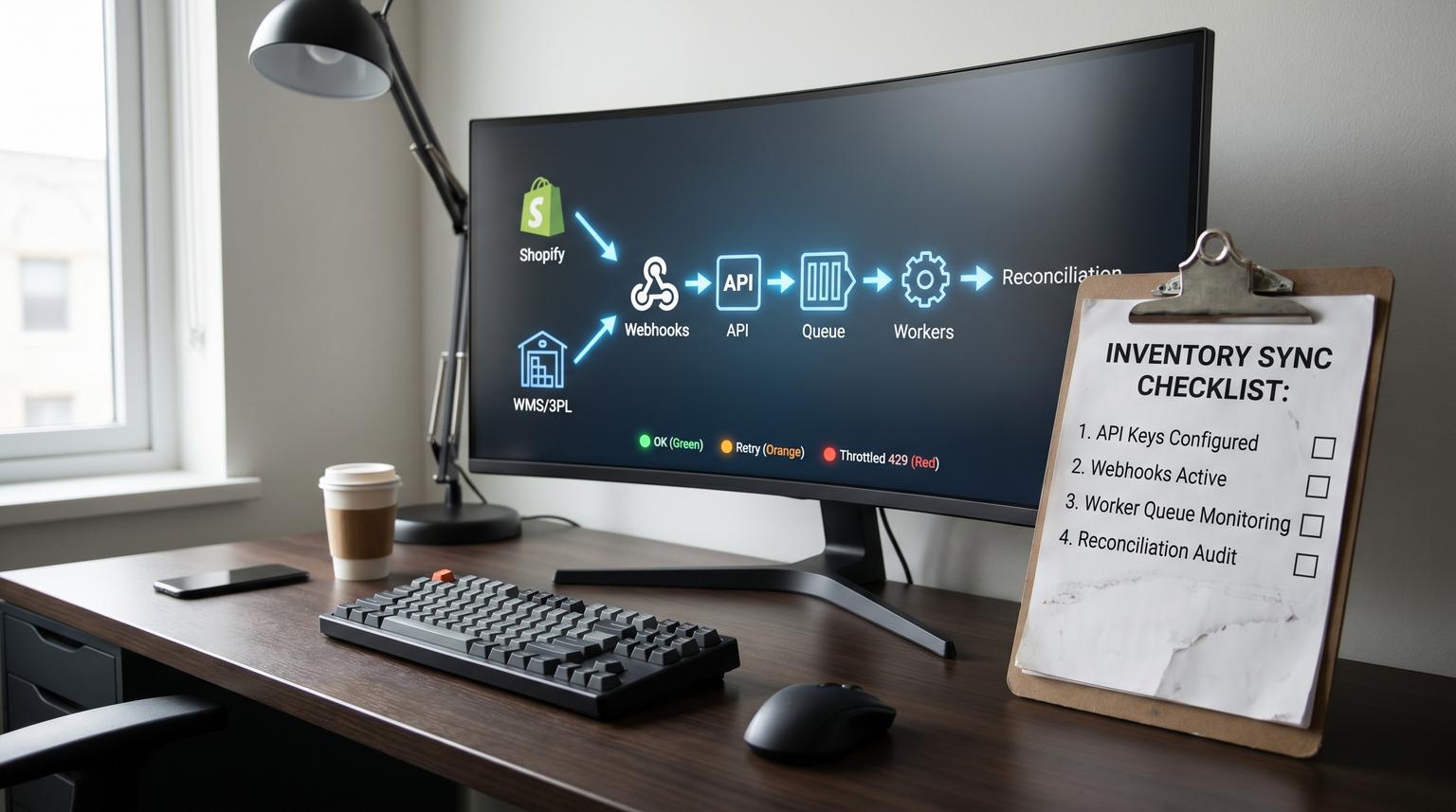
Real-time Shopify to 3PL/WMS inventory sync looks simple until the first time a webhook drops, a retry double-writes stock or a partial shipment lands in the wrong state. This is where custom API integration services should be evaluated like an operations decision not a tooling decision. This article gives ops and eCommerce teams a practical way to choose between direct API, custom middleware or an iPaaS approach so inventory, orders, fulfillments and tracking stay consistent without oversells.
Quick summary:
- Oversells usually come from reliability gaps: missed or duplicated events, throttling and partial fulfillment edge cases not from missing features.
- Pick an architecture based on volume and latency, replay and idempotency needs and your 3PL/WMS API and webhook constraints.
- For most growing stores, a thin webhook receiver plus a durable queue plus a verifier job prevents the most expensive failures.
- If you cannot replay and reconcile by design, you will reconcile manually under pressure.
Quick start
- List your high-risk events: inventory changes, order creation, allocation or reservation, fulfillment updates and tracking updates.
- Write down your worst acceptable outcome: oversell, negative available, canceled orders, delayed shipping promises or support ticket spikes.
- Estimate peak event rate (orders per minute and inventory adjustments per minute) and required latency (seconds vs minutes).
- Decide your recovery standard: can you replay safely with idempotency and a durable event log or do you need manual fixes.
- Map your constraints to the decision matrix below then validate against your 3PL webhook timeout, retries and API limits.
Choose direct API when volume is low and recovery can be simple. Choose middleware when you need durable replay, multi-location logic and tighter control. Choose iPaaS when you need faster time to value and a central control plane but confirm it can support idempotency keys and deterministic retries.
Why Shopify to 3PL/WMS inventory sync fails in the real world
Most teams start with a reasonable goal: keep on-hand and available quantities aligned between Shopify and the warehouse system. The failure mode is that the connection is event-driven and distributed. The moment you rely on webhooks as the source of truth, you inherit at-least-once delivery, occasional drops and duplicate notifications. Shopify explicitly calls out that webhooks are not guaranteed and that you should build idempotent processing and reconciliation jobs as a normal part of your design (Shopify webhook best practices).
On the 3PL side the situation is similar. Many WMS providers retry for a short time and they can deactivate a webhook endpoint that fails repeatedly. ShipHero for example uses a 10 second timeout and limited retries and recommends verifying real-time status via API for processes that require confirmation (ShipHero webhooks). If you do heavy work inside the webhook handler, you increase the chance of timeouts and eventual deactivation.
There is also a Shopify-specific complexity that drives architecture choice: multi-location inventory is not one number. Inventory is per inventory item per location and fulfillment service locations carry constraints that can break naive sync logic when locations or fulfillment settings change (Shopify InventoryLevel resource).
The three approaches and what they optimize for
1) Direct API integration (point-to-point)
This is a custom service that subscribes to Shopify webhooks and calls the 3PL API or that polls one system and writes to the other. It optimizes for speed of build and minimal moving parts. It can be a great fit when you have low volume, simple single-warehouse rules and a team that can maintain code and monitoring.
2) Custom middleware (your integration layer)
This is a dedicated integration layer that sits between Shopify and the 3PL/WMS. It usually includes a fast webhook ingest endpoint, a queue or event bus, workers, a state store and a reconciliation scheduler. It optimizes for reliability, replay, observability and controlled complexity. Middleware is the safest option when oversell risk is high and the process must survive retries, throttling and schema changes.
3) iPaaS (integration platform as a service)
An iPaaS gives you connectors, mapping and a centralized place to monitor flows. It optimizes for faster time to value, easier changes and a single control plane. The risk is that not all iPaaS setups handle commerce-grade idempotency and deterministic retries well by default. For inventory writes and fulfillment state transitions, you must validate how it generates request IDs, how it retries after 429 throttles and whether it can persist an event log you can replay safely.
Decision matrix for Shopify to 3PL/WMS real-time inventory sync
Use this matrix to map (1) volume and latency needs, (2) failure recovery requirements and (3) 3PL/WMS constraints to a best-fit approach. The goal is not theoretical elegance. The goal is preventing oversells and reducing reconciliation time.

| Decision drivers | Direct API | Custom middleware | iPaaS |
|---|---|---|---|
| Volume and latency Low volume (tens of orders/day) and minutes-level latency ok |
Best fit. Keep it simple and ship faster. | Can be overkill unless multi-location rules are complex. | Good fit if you want visibility without building it. |
| Volume and latency Spiky volume, flash sales, frequent stock movement and seconds-level latency |
Risky unless you build queues and backpressure handling. | Best fit. Buffer spikes and process asynchronously. | Possible fit if it supports queueing patterns and fast ACK webhooks. |
| Failure recovery You need replay, idempotency and an audit trail per SKU and per order |
Only fit if you implement a durable event log and idempotency keys yourself. | Best fit. Durable log plus replay tooling becomes a core feature. | Fit only if it can persist events and guarantee deterministic retries and idempotency key reuse. |
| 3PL/WMS webhook reality Short timeouts, limited retries, possible deactivation |
Risky if webhook handler does heavy work. You will time out. | Best fit. Thin receiver acknowledges fast and queues work. | Fit if it provides a reliable webhook gateway or you front it with a thin receiver. |
| 3PL/WMS API constraints Aggressive rate limits or inconsistent endpoints for partial shipments and backorders |
Often fragile. You will hit throttles and lose ordering guarantees. | Best fit. Central throttling, batching and state verification. | Mixed. Confirm you can control retry timing, ordering and verification calls. |
| Shopify constraints Multi-location and fulfillment service location rules |
Possible but error-prone. Location mapping logic must be rock solid. | Best fit when you need a location ownership resolver and consistent rules. | Fit for simpler mappings. Complex ownership rules often require custom code. |
Architecture choices that directly reduce oversells
Regardless of approach, oversells usually happen when the system believes inventory is available when it is not. That happens when you lose an update, apply an update twice or apply it to the wrong location. The following design choices matter more than which tool you use. For a deeper, repeatable approach to reliability patterns like retries, idempotency, DLQs and rate-limit handling, use the API integration engineering playbook.
Use a thin webhook receiver and process out-of-band
The webhook endpoint should do three things only: verify signature, persist the event and return a 2xx quickly. Shopify notes that duplicates can occur and that you should design for it. ShipHero enforces short timeouts. The operational implication is simple: do not parse, map and write to both systems inside the webhook request.
Prefer idempotent inventory writes and store operation receipts
Inventory writes are side effects. If a worker crashes after writing to Shopify but before recording success, it will retry. Without idempotency, you get double adjustments and drift. Shopify supports idempotency keys for many GraphQL mutations and retains keys for 24 hours (Shopify idempotency). Use that window intentionally: generate a deterministic key per business operation such as order_id plus line_item_id plus event_type plus event_created_at then reuse it across retries. Store the request payload hash and the response so you can prove what happened later.

Design for multi-location truth not a single stock number
If your 3PL is represented as a fulfillment service location in Shopify, you have connection and disconnection constraints that can break naive approaches. Inventory is per location and some items cannot be connected to multiple locations at the same time. That means you need a location ownership resolver that decides which location_id gets which adjustments and when to use connect or disconnect behaviors. If your current process includes manual location edits in Shopify Admin, assume the integration will eventually face unexpected location states and build reconciliation for it.
A practical decision checklist before you commit
Use this checklist to turn the matrix into a clear recommendation for your team.
- How costly is one oversell? Include refunds, reships, chargebacks, support time and brand impact. If the cost is high, prioritize replay and observability.
- What is your peak event rate? Count inventory-changing events, not just orders. Promotions and inbound receiving can generate huge bursts.
- Can you tolerate minutes of lag? If no, you need queueing and backpressure so you do not collapse under spikes.
- Do you need to support partial shipments, split fulfillments or backorders? If yes, you need a state machine not a single status field.
- How many locations and warehouses exist today and likely next quarter? Multi-location growth is where point-to-point designs often break.
- Do you require replay? Ask, "If we lose two hours of events, can we safely rebuild state without guessing?"
- Can your chosen approach verify by API? Webhook plus verify is a safer default for high-stakes state changes.
- Who will own monitoring and on-call? If nobody will, avoid architectures that require constant babysitting.
Common failure pattern that causes negative stock and oversells
A pattern we see in fast-growing stores is delta-based updates chained across systems without a durable event log. Example: the 3PL sends an inventory adjustment webhook, the integration subtracts that delta from Shopify and then Shopify sends an inventory webhook that triggers another sync back to the 3PL. When one webhook is duplicated or arrives out of order, the same delta applies twice. When rate limits trigger retries, the same delta applies twice again. The team then "fixes" it with manual inventory edits which introduces more noise.
A simple rule prevents most of this: pick one direction of truth for each field and make every write replay-safe. For inventory, that often means the WMS is truth for on-hand while Shopify is truth for storefront availability rules and reservations. Then you use reconciliation jobs to close the gaps that webhooks cannot guarantee.
What to build for each approach
Direct API build that is still safe enough (small teams)
If you choose direct API, do not skip the reliability layer. At minimum build:
- A fast webhook receiver that stores raw payloads and headers
- A dedupe table keyed by webhook id plus topic plus created_at
- A worker queue with retry policy and 429 backoff
- Idempotency key storage for Shopify writes and a "receipt" record per write
- A scheduled reconciliation job that pulls updates by updated_at and replays missing work, as Shopify recommends
Middleware build (growing and high-volume catalogs)
Middleware becomes the right call when you need predictable operations. A good baseline includes:
- Ingress: webhook gateway with signature verification and fast ACK (see how a webhook gateway pattern prevents duplicate writes and adds DLQ recovery)
- Durable event log: append-only store of events and processing status
- Workers: per-domain processors (inventory, orders, fulfillments, tracking)
- State verification: API reads to confirm final state on key transitions
- Reconciliation: catch-up jobs per object type with backfill controls
- Control plane: dashboards for stuck events, replay tooling and alerting
iPaaS build (fast time to value with guardrails)
An iPaaS can work well when you treat it as orchestration plus monitoring and you validate the hard parts:
- Can it ACK webhooks quickly without doing heavy transforms inline?
- Can it preserve ordering per order and per SKU when required?
- Can it generate and reuse stable idempotency keys for 24 hours?
- Can you inspect and replay failed runs deterministically?
- Can you add a custom code step for multi-location mapping rules?
Recommendation path by store stage
Small team with one warehouse and modest SKU movement
Start with a direct integration only if you commit to idempotency, dedupe and reconciliation from day one. If you cannot do that, use an integration platform with strong run history and alerting so you can see failures before customers do.
Fast-growing store with frequent promotions and multiple locations
Pick middleware or a hybrid where a thin custom receiver and queue feed into your iPaaS flows. Your main requirement is replayable recovery: when something goes wrong you can re-run the last N hours safely without double-writing inventory.
High-volume catalogs with frequent stock movement and strict SLA
Use middleware with a durable event log and explicit state machines for fulfillments and backorders. At this scale, rate limiting and out-of-order events are normal. You want centralized throttling, verification reads and tooling that operations can use without engineering involvement.
If you want help choosing the safest option for your specific Shopify and 3PL/WMS setup, book a consultation with ThinkBot Agency. We will map your volume, failure modes and location rules to an integration architecture you can operate confidently. If you want a broader view of benefits and tradeoffs, see how API integration services transform efficiency and customer experience.
When this is not the best fit: if your catalog is tiny, your fulfillment is in-house and you can tolerate occasional manual adjustments, a real-time sync project may be more complexity than value. In that case, a daily reconciliation report plus controlled manual updates can be the better operational choice until volume increases.
FAQ
Common follow-ups we hear when teams are selecting an integration approach for Shopify and a 3PL/WMS.
How do we prevent duplicate webhook processing from changing inventory twice?
Use deduplication plus idempotency. Persist every webhook event with a unique key, mark it processed and make downstream writes replay-safe. For Shopify writes, reuse the same idempotency key across retries within the 24 hour retention window and store a receipt of the response.
Should inventory updates be delta-based (adjust) or absolute (set)?
Delta updates are efficient but they amplify duplicates and ordering issues. Absolute set updates are often safer for reconciliation and drift correction, especially when you can confirm the WMS on-hand quantity as truth. Many robust setups use deltas for normal flow and periodic absolute sets for reconciliation.
What is the minimum viable reconciliation job for a reliable sync?
At minimum, run a scheduled catch-up that pulls recently updated orders, fulfillments and inventory levels by timestamp, compares expected state and replays missing actions. This closes gaps when webhooks are delayed, dropped or your processor was down.
When does point-to-point become too fragile for Shopify to 3PL syncing?
It becomes fragile when you have multi-location complexity, frequent partial fulfillments or backorders, spiky volume that hits rate limits or an operations requirement to replay the last few hours without manual cleanup. Those conditions call for a centralized layer with durable logging and controlled retries.
