
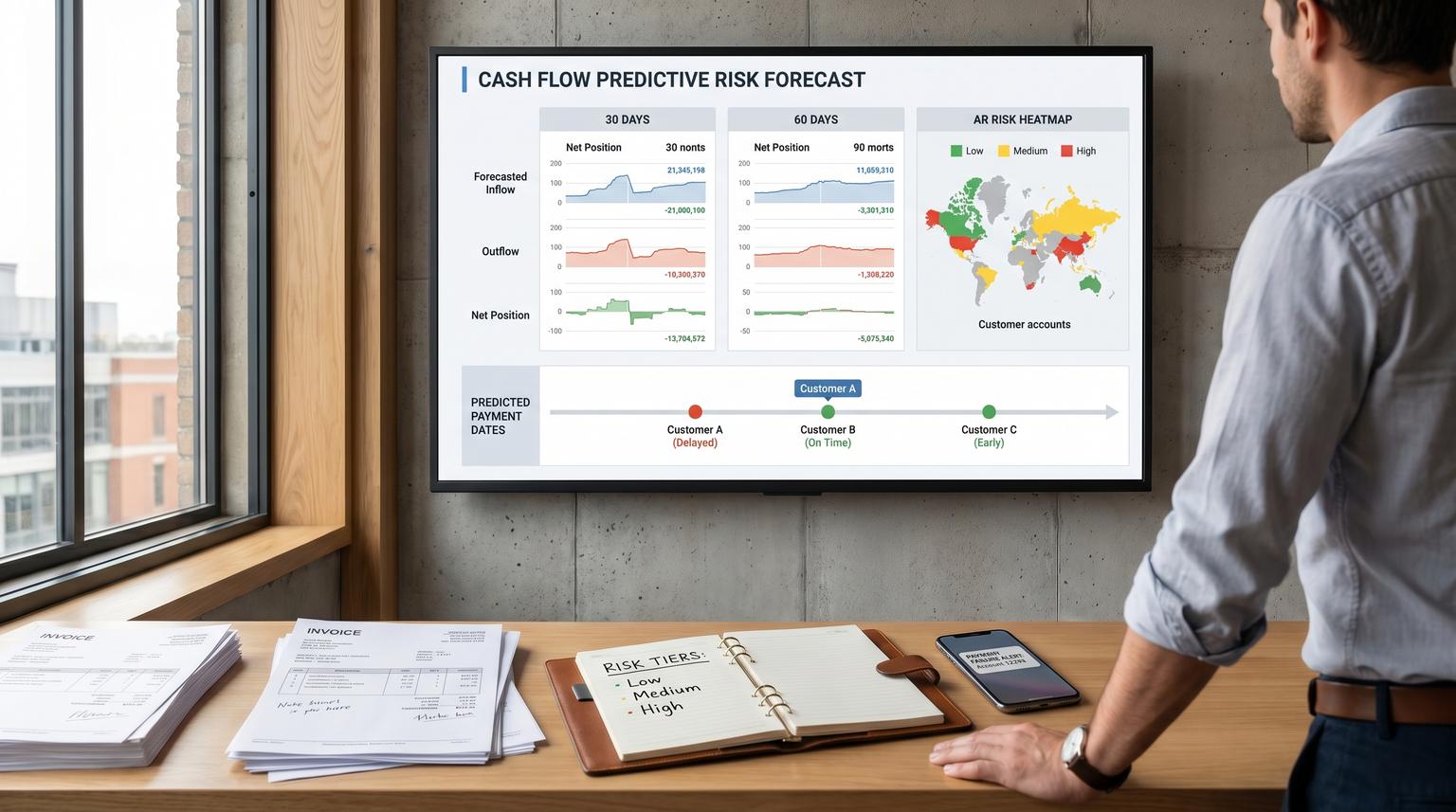
Late payments rarely show up as a crisis on the day an invoice is issued. They show up weeks later when payroll, vendor bills and growth plans collide with a cash gap you did not forecast accurately. This post shows how to use predictive analytics for business to build an automated cash-flow early warning system that unifies Stripe events, QuickBooks invoice truth and CRM workflows so your team can act earlier with consistent outreach and clean governance.
At a glance:
- Unify Stripe invoice events and QuickBooks invoice state into one invoice-level risk score and predicted payment date.
- Write risk tier fields back to your CRM so collections actions happen in one place with de-duplication guardrails.
- Trigger tiered automations by risk level without double-contacting customers or running conflicting sequences.
- Forecast next-30/60/90 day cash impact by combining predicted payment dates with open AR balances.
Quick start
- Choose your systems of record: Stripe and QuickBooks for financial truth and your CRM as the action hub.
- Stand up two data feeds: Stripe webhooks for fast signals and QuickBooks CDC for authoritative invoice and payment updates.
- Compute an invoice risk score (0-100) on invoice finalization and daily for open invoices near due.
- Write score, tier, predicted payment date and sequence state back to the CRM invoice and company records.
- Trigger tiered collections workflows with suppression windows and a single active sequence per invoice.
A practical cash-flow early warning system combines real-time payment signals (Stripe) with accounting truth (QuickBooks) then converts those signals into controlled CRM actions. You score each open invoice for late-payment likelihood, estimate a realistic paid date, roll those predictions into 30/60/90-day cash expectations and trigger the right outreach or internal tasks based on risk tier. The key is governance so customers do not receive duplicate reminders from multiple systems.
Architecture and system boundary
The cleanest implementation is to treat Stripe and QuickBooks as sources of financial truth and the CRM as the workflow engine. That boundary prevents a common failure pattern: teams trying to run collections inside Stripe, inside QuickBooks and inside the CRM at the same time which leads to inconsistent status and over-contacting.
- Stripe: fastest signals about invoice creation, finalization, payment failure and payment success. Its webhook retries mean you must process events idempotently. Stripe invoice state transitions are your timing anchors for when scoring is allowed and when sequences must stop.
- QuickBooks: authoritative for invoice balance, due date edits, partial payments, credits and manual adjustments. Use incremental sync so your score and your CRM do not drift from accounting.
- CRM (HubSpot or similar): the action hub where risk tier drives tasks, sequences and escalation. It is also where you store suppression windows and sequence state to prevent conflicting outreach.
- Scoring service: a small service or n8n workflow that turns invoice and customer features into a score and predicted paid date then writes back to the CRM.
Decision rule: if two systems disagree, the workflow should prefer QuickBooks for balance and due date and prefer Stripe for payment attempt outcomes that may not be posted to QuickBooks yet. That gives you early warning without letting early signals overwrite accounting truth.
Data capture from Stripe and QuickBooks without drift
Stripe webhook intake for fast payment-risk signals
Consume a focused set of Stripe events and map them to scoring checkpoints and suppression conditions. Stripe retries webhook delivery for up to about three days with exponential backoff so your handler must be safe to reprocess the same event.
| Stripe status or event | What it means operationally | Allowed actions | Suppress or stop when |
|---|---|---|---|
| invoice.created | Invoice exists but may not be payable yet | Optionally create a placeholder record and wait | Do not start outreach from this event |
| invoice.finalized | Invoice becomes open and payable | Initialize risk record and compute initial score | Suppress if invoice is void or uncollectible |
| invoice.payment_failed | Payment attempt failed and retries may occur | Escalate risk tier and start controlled dunning | Delay pause-services actions until retry window passes |
| invoice.paid | Definitive payment success | Stop sequences and clear risk tier where appropriate | Always stop outreach and close tasks |
| invoice.voided or marked uncollectible | Terminal outcome for that invoice | Stop sequences and mark suppressed | Always suppress future dunning for that invoice |
Implementation insight from real ops: score on invoice.finalized then rescore daily for open invoices in the next 14 days. That avoids churn from every small invoice.updated mutation and still catches the cases that create cash surprises.
QuickBooks change data capture for authoritative invoice truth
Use QuickBooks Online Change Data Capture (CDC) for Invoice and Payment-related entities so you can keep balances and due dates synchronized without pulling everything nightly. CDC only goes back 30 days and returns up to 1,000 objects per call so run it at least daily and shrink the polling window if volume spikes.
GET https://quickbooks.api.intuit.com/v3/company/<realmId>/cdc?entities=Invoice,Payment&changedSince=<dateTime>
Pair CDC with targeted queries for backfills and audits. QuickBooks queries do not support joins so you will join entities in your own store by IDs like CustomerRef.

Minimal operational data model
Keep two stores:
- Operational store: latest invoice state used for scoring and CRM updates.
- History store: snapshots needed for features like customer payment habits and days-late distributions.
At minimum store:
- invoice_id (Stripe and or QuickBooks)
- customer_id mapping across systems
- invoice_amount, open_balance, due_date, issued_date
- stripe_status, quickbooks_status, last_payment_attempt_at, failure_reason if any
- days_past_due (derived), prior_days_late_avg (derived)
Concrete risk-scoring workflow that predicts late payments
The goal is not academic modeling. The goal is a stable score that finance and ops can trust enough to automate actions. Start with a transparent rules-based score that you can later upgrade to a trained model if you want; if you want a broader pattern library for designing reliable AI steps in automations, use this AI workflow automation playbook as a companion.
Inputs
- Invoice features: amount, due date proximity, payment terms, whether it is subscription vs one-off, number of prior payment failures for this invoice.
- Customer behavior features: average days late over last N invoices, percent of invoices paid late, number of overdue invoices currently open, disputes or chargebacks flags if you track them, total open AR exposure.
- System signals: Stripe payment_failed and retry state, QuickBooks balance and partial payments, manual due date changes.
Scoring logic (0-100) with thresholds
Here is a concrete starting point that works well operationally because it is explainable. It also produces a predicted days-late value you can use for cash forecasting.
- Base score: 10
- Customer late history:
- +25 if last 6 invoices average > 7 days late
- +15 if last 6 invoices average 1 to 7 days late
- +20 if more than 40% of last 10 invoices were late
- Current AR exposure:
- +15 if customer has 2+ open invoices with balance > 0
- +10 if total open balance for customer exceeds your internal credit threshold
- Invoice timing risk:
- +10 if due date is within 5 days and balance remains > 80%
- +20 if invoice is already overdue by 1 to 7 days
- +35 if invoice is overdue by 8+ days
- Stripe payment failure signals:
- +25 on invoice.payment_failed (but do not escalate pause-services immediately)
- +10 if payment method update is required or you see repeated failures in 48 hours
- Credits and partial payments:
- -15 if a partial payment of at least 50% is recorded in QuickBooks within the last 3 days
- -10 if a credit memo is applied reducing balance significantly
Clamp the final score between 0 and 100.
Risk tiers:
- Low: 0-39
- Medium: 40-69
- High: 70-100
Predicted days late: start from customer average days late then adjust:
- +7 days if score is Medium
- +14 days if score is High
- +10 days if invoice.payment_failed occurred in the last 24 hours
- -7 days if customer has a pattern of paying early and this invoice is not near due
Predicted payment date: due_date + predicted_days_late (never earlier than today).

This is a tradeoff: rules-based scoring is less precise than a trained model but it is easier to govern. In collections automation, stability and explainability often beat a slightly better AUC because the cost of the wrong action is a damaged relationship.
Cash-flow forecast for next 30/60/90 days
For each open invoice, place its open_balance into a forecast bucket based on predicted payment date:
- Expected in 0-30 days
- Expected in 31-60 days
- Expected in 61-90 days
- At risk beyond 90 days
Then roll up by customer and by segment. The outcome is an early warning view that explains not only what is overdue but what is likely to slip soon and how big the gap could be; for related patterns on keeping decision dashboards fresh with automated syncs and alerts, see AI-driven business intelligence dashboards with n8n.
CRM write-back contract and identity mapping
Write-back is what turns prediction into action. Keep the write-back surface area small and consistent so ops can trust it. Use stable external ID properties so you update the correct CRM records every time.
Recommended CRM fields (invoice object and company object)
- invoice_risk_score (number 0-100)
- invoice_risk_tier (enum: low, medium, high)
- predicted_days_late (number)
- predicted_payment_date (date)
- last_scored_at (datetime)
- collections_sequence_state (enum: none, active, paused, stopped)
- active_sequence_id (text)
- outreach_suppression_until (datetime)
- last_customer_contacted_at (datetime)
On the company record, write rollups such as:
- open_ar_balance
- open_invoice_count
- cashflow_risk_flag_30d (boolean)
Identity spec (prevents duplicate and conflicting updates)
- hubspot_invoice_external_id = Stripe invoice id or QuickBooks invoice id (choose one and store the other as secondary)
- hubspot_company_external_id = QuickBooks Customer Id
- Store a mapping table in your integration layer that links Stripe customer, QuickBooks customer and CRM company
If you are using HubSpot, update properties via PATCH on CRM objects and clear values by setting empty strings when an invoice is paid or voided. This keeps lifecycle transitions clean and avoids stale risk tiers lingering on closed invoices.
Example write-back payload (generic)
{
"properties": {
"invoice_risk_score": "78",
"invoice_risk_tier": "high",
"predicted_days_late": "21",
"predicted_payment_date": "2026-05-18",
"last_scored_at": "2026-04-22T10:15:00Z",
"collections_sequence_state": "active",
"active_sequence_id": "dunning_high_v2",
"outreach_suppression_until": "2026-04-24T10:15:00Z"
}
}
Tiered collections automations that do not spam customers
The scoring layer is only useful if it reliably triggers the right action and reliably stops when payment happens. The biggest real-world failure is duplicated outreach: Stripe emails, QuickBooks reminders and CRM sequences all firing independently; for a deeper look at what can go wrong at the CRM/API boundary and how to build safe writes and retries, use a failure map for AI automation in business workflows.
Tier actions (example)
- Low risk: no collections sequence. Optional friendly reminder 3 days before due if you normally do that. Create no tasks.
- Medium risk: start a short dunning sequence from the CRM (email and optional SMS if you have consent). Create a task for an account owner if the invoice is within 5 days of due and balance remains high.
- High risk: start an intensified sequence plus internal escalation. Create a finance task at invoice.finalized for large invoices and escalate to a finance lead if the invoice becomes overdue. If you have a services team, send an internal notification to review deliverables and contract terms.
Governance guardrails (de-duplication and conflict prevention)
Use a small control layer in your CRM and integration workflows:
- Single active sequence per invoice: if collections_sequence_state is active then do not enroll again.
- Suppression window: set outreach_suppression_until for 24 to 72 hours after any customer touch. Check it before sending any new outreach.
- Idempotency keys: store processed_event_id for Stripe webhooks and processed_cdc_cursor for QuickBooks sync. If the same event arrives again, acknowledge and skip actions.
- Channel ownership: choose one system to send external reminders. In most teams that should be the CRM so message history is centralized.
- Stop conditions: any transition to paid, void or uncollectible must immediately stop the sequence and clear active_sequence_id.
Common mistake: treating invoice.payment_failed as an immediate reason to pause services. For subscription invoices, Stripe may retry automatically. A better approach is to move the invoice to High risk, start a payment-method update request and only trigger a pause-services notification if failures persist past your retry window or the invoice becomes meaningfully overdue.
Webhook and sync reliability checklist
- Verify Stripe webhook signatures and log event ids.
- Return 2xx quickly then process asynchronously to avoid timeout retries.
- Persist a dedupe table keyed by (event_id, invoice_id) with status processed.
- For QuickBooks CDC, store last successful changedSince timestamp and back off to shorter windows if you approach 1,000 objects.
- Reconcile mismatches daily: QuickBooks open balance vs Stripe paid events vs CRM invoice status.
- On any write-back failure, retry with exponential backoff and alert when the risk tier could be stale.
Implementation in n8n with clean handoffs
ThinkBot Agency builds many of these systems in n8n because it is fast to iterate and strong for API orchestration and governance. A typical setup uses three workflows:
- Stripe webhook workflow: intake events, dedupe, update operational store, trigger score for invoice.finalized and invoice.payment_failed and stop actions for invoice.paid.
- QuickBooks CDC workflow: scheduled hourly or daily, ingest changed invoices and payments, update operational store, rescore invoices that changed materially (balance, due date, partial payment).
- Daily scoring and forecast workflow: pull open invoices with due dates within horizon, compute score and predicted date, write back to CRM, compute rollup flags for 30/60/90 day buckets.
When this approach is not the best fit: if your invoicing and payment stack is mostly offline (manual bank transfers and no reliable event signals) or if you have very low invoice volume, a simpler AR aging report plus disciplined reminder process may get you 80% of the benefit with less integration overhead.
Rollout, monitoring and continuous improvement
Deploying this system is as much operations as it is data. Start with a shadow mode where you score invoices and write back fields but do not trigger customer outreach for 2 to 4 weeks. During that time, validate:
- Stripe event timing and retries do not create duplicated sequences.
- QuickBooks CDC keeps balances and due dates aligned.
- Risk tiers match human judgment for your top 20 accounts.
- Predicted payment dates are directionally correct for cash planning.
After shadow mode, enable automations for Medium risk only then add High risk escalation once you are confident in guardrails. Keep a manual override in the CRM so finance can set collections_sequence_state to paused for sensitive accounts.
If you want help implementing this end to end in your stack (Stripe, QuickBooks and your CRM) you can book a consultation and we will map your invoice lifecycle, data contracts and outreach governance before writing a single workflow.
Prefer to see similar automation builds first? Review our portfolio.
FAQ
Common implementation questions we hear from ops and finance teams building an automated cash-flow warning system.
Do I need machine learning to predict late payments?
No. Many teams get strong results with a transparent rules-based score that uses invoice timing, customer payment history and payment failure signals. You can later train a model once you have clean labels like paid date and days late but the automation and governance layer is usually the hardest part.
How often should the risk score be recalculated?
Recalculate at stable lifecycle checkpoints like Stripe invoice.finalized and after meaningful QuickBooks changes like balance, due date or partial payments. In addition run a daily scoring job for open invoices within a 14-day horizon so you catch growing risk without reacting to every minor update event.
What prevents customers from getting duplicate reminders from Stripe, QuickBooks and the CRM?
Make the CRM the single outbound channel for collections messaging then store collections_sequence_state, active_sequence_id and outreach_suppression_until on the invoice record. Your workflows should check those fields before enrolling or sending any reminder and must stop sequences immediately when Stripe or QuickBooks confirms payment.
Which system should be treated as the source of truth when data conflicts?
Use QuickBooks as the source of truth for invoice balance and due date since it reflects accounting adjustments, credits and partial payments. Use Stripe as the source of truth for payment attempts and immediate payment success or failure signals. Your integration should reconcile daily and avoid overwriting accounting truth with early payment signals.
