
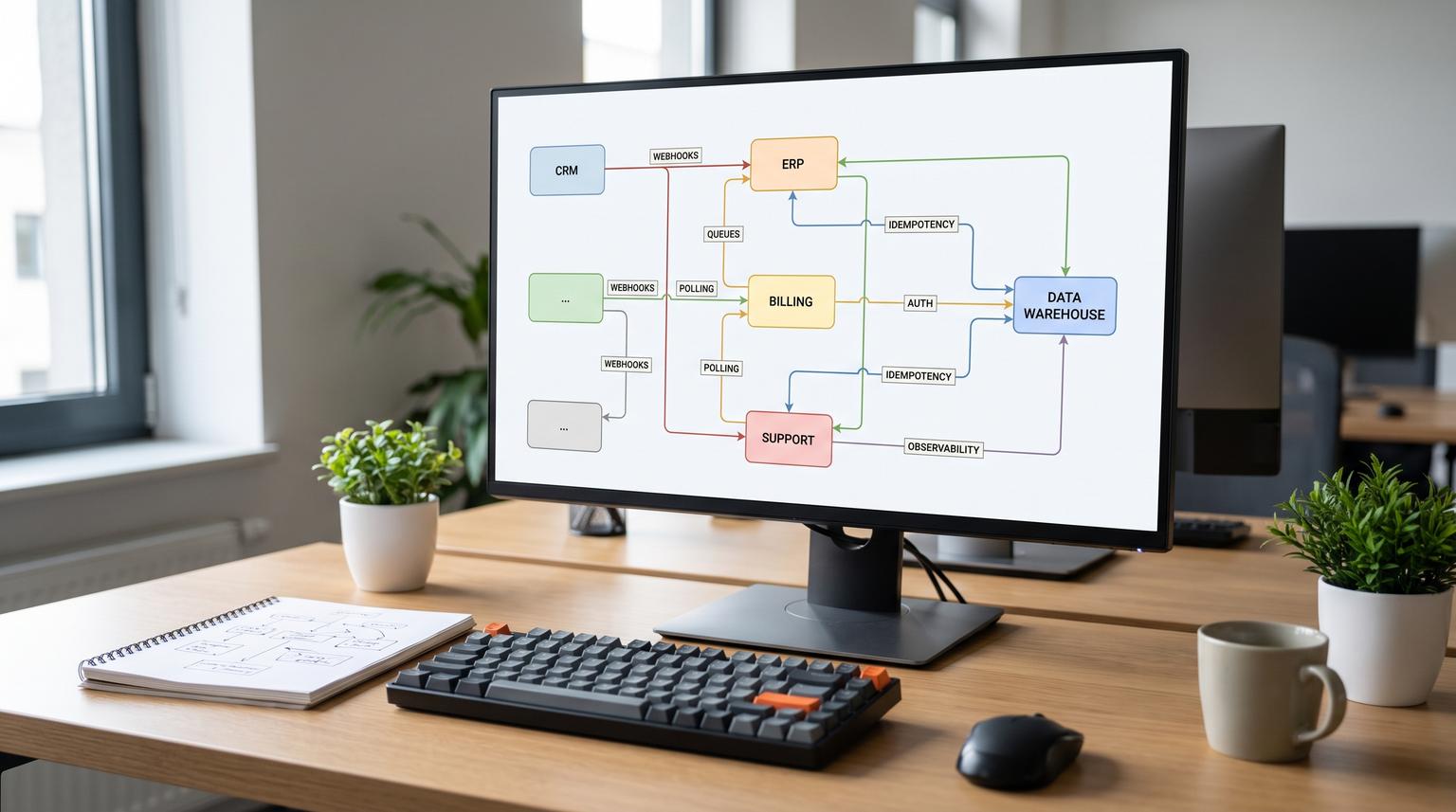
Teams rarely struggle with getting an API call to work once. They struggle with making it run every day, under rate limits, with partial outages, vendor changes and real security constraints. This playbook is a practical framework for production API integration across modern business systems like CRM, ERP, billing, support and data warehouses. It focuses on repeatable patterns, reliability engineering and security controls so your workflows stay correct and maintainable as systems evolve.
It is written for business owners, ops managers, RevOps and marketing ops teams and tech-savvy founders who need integrations that can take a hit. Think of it as the operating manual for moving from proof-of-concept automation to a production-grade integration surface you can monitor, audit and safely change.
At a glance:
- Pick the right transport pattern (sync, webhook, polling, queue) based on business risk and failure tolerance.
- Design for duplicates and unknown outcomes using idempotency keys and upsert semantics.
- Treat auth as a lifecycle (least privilege, secret storage, rotation, revocation), not a setup step.
- Make data mapping explicit with validation gates and versioned contracts.
- Engineer reliability: timeouts, bounded retries with backoff, circuit breakers and DLQs.
- Operate it: structured logs, correlation IDs, monitoring, alerts, runbooks and change management.
Quick start
- Write down the business transaction and the system of record for each entity (lead, contact, invoice, ticket, order).
- Choose an integration pattern per flow: request/response for user-facing reads, webhooks for near-real-time events, polling for systems without push, queues for write-heavy or high-risk updates.
- Define a contract: required fields, IDs, and a canonical model. Add schema validation at the boundary.
- Implement auth with least privilege, store secrets in a secret manager, and plan token/key rotation.
- Add idempotency keys for writes, plus a dedupe strategy for webhook retries and replay.
- Build resilience: explicit timeouts, bounded retries with exponential backoff and jitter, circuit breakers for hard outages, and a DLQ for poison messages.
- Instrument operations: correlation IDs, structured logs, metrics for throughput/latency/error, alerts and a runbook for replay and rollback.
A production-grade API integration connects business systems using the right communication pattern (sync, webhook, polling, or queue), explicit data contracts and validation, secure authentication with secret storage and rotation and reliability controls like idempotency, bounded retries, rate-limit handling and dead-letter queues. The goal is not just moving data, it is maintaining correctness during retries, partial failures and vendor changes while keeping the integration observable, auditable and safe to evolve.
Table of contents
- Why most integrations fail in production (and how to avoid it)
- The integration architecture patterns you will actually use
- Orchestration vs choreography: choosing where the process lives
- Data contracts, mapping, and validation gates
- Idempotency and deduplication: designing for retries and replay
- Reliability engineering: timeouts, retries, breakers, and DLQs
- Rate limits, pagination, and backpressure
- Security model: auth, secrets, and token lifecycle
- Testing and change management for evolving APIs
- Operations checklist: monitoring, logging, audits, and ownership
- Common use-case patterns across business systems
- How ThinkBot Agency implements production-grade integrations
- FAQ
Why most integrations fail in production (and how to avoid it)
Most teams ship an integration that works in a happy-path demo, then it degrades quietly over weeks: duplicates creep in, rate limits cause backlogs, vendor APIs change behavior, a token expires, or a partial outage creates inconsistent state between tools. Production failures are usually not about syntax. They are about missing system behaviors: retries, ordering, idempotency, observability, security and ownership.
A useful mindset is to treat every integration as a distributed system. That means you should assume:
- Messages can be duplicated and delayed.
- Requests can time out even if the vendor processed them.
- Dependencies can be partially down (some endpoints fail, some succeed).
- Data contracts will drift over time.
- Authentication artifacts will expire or be revoked.
If you want a business-level view of what custom connectivity unlocks, start with custom integrations. If you are deciding between an iPaaS connector and custom middleware for reliability and governance, see this decision guide.
The integration architecture patterns you will actually use
Most production integration surfaces are built from a small set of patterns. The goal is to choose intentionally based on user experience, risk, throughput and failure modes, not on what is easiest to prototype.
Request/response (sync API calls)
Use synchronous calls when a user or upstream workflow needs an immediate result, typically reads or low-risk writes. Guardrails: short timeouts, clear error mapping and conservative retries. If you cannot tolerate duplicate writes, do not blindly retry non-idempotent operations.
Event-driven webhooks
Webhooks are ideal for near-real-time event delivery from SaaS tools, but they inherently require you to handle retries and duplicates. A production webhook pipeline should include verification (signatures), validation gates and an idempotent consumer. If your core issue is duplicate CRM writes, we have a deep pattern write-up on webhook gateways.
Polling (scheduled pulls)
Polling is often necessary for systems that do not support webhooks or where you need a reconciliation loop. Production polling requires incremental sync strategies (updated_since, cursor pagination) and careful rate-limit coordination. Polling is also valuable as a safety net to reconcile after an outage or a period of missed webhooks.
Queue-based async processing
Queues turn risky, bursty and write-heavy workloads into controlled throughput. They decouple producers and consumers, allow backpressure and make bounded retries feasible. For high-value writes (orders, invoices, lifecycle events), a queue plus idempotent consumers is usually the safest default.
Comparison: when to use each pattern

| Pattern | Best for | Main risk | Production guardrail |
|---|---|---|---|
| Request/response | User-facing reads, simple actions | Timeouts and unknown outcomes | Short timeouts, idempotency for writes, clear retries |
| Webhooks | Near-real-time change events | Duplicates, out-of-order delivery | Signature verification, idempotent upsert, replay support |
| Polling | Systems without push, reconciliation | Rate limits, missed deltas | Cursors, checkpoints, incremental windows, backoff |
| Queues (async) | Burst control, high-risk writes | Poison messages, operational overhead | DLQ, bounded retries, consumer idempotency, runbooks |
Many real deployments blend these patterns. For example, a webhook ingests events into a queue, then async workers apply updates to CRM and billing with idempotent upserts.
Orchestration vs choreography: choosing where the process lives
A core architectural decision is where the business process knowledge lives: in a central workflow (orchestrator) or distributed across services reacting to events (choreography). The tradeoff is control and debuggability vs autonomy and loose coupling. n8n frames this as a practical choice based on workflow complexity, number of participants, blast radius of failures and audit needs, with many teams using a hybrid approach in production (n8n).
In orchestration, a coordinator calls systems in sequence, applies timeouts and triggers compensating actions. In choreography, services publish and consume events, and the overall process emerges from message exchange. Doubleslash highlights a common pitfall: choreography can create hidden coupling unless you document explicit event contracts, while orchestration can become a monolith-in-disguise if it absorbs domain rules (source).
If you are implementing complex cross-tool business workflows, you will often start with orchestration for the critical path, then add choreographed event hooks for optional fan-out and analytics.
Data contracts, mapping, and validation gates
Data mapping is not a cosmetic transformation step. It is a reliability boundary. Integrations fail when transformation rules are implicit, scattered or untested. n8n recommends making mappings explicit and modular, normalizing formats early and validating required fields before sending to downstream systems (source).
A practical way to reduce fragility is to introduce a canonical model for key entities (contact, company, invoice, ticket) and keep source-specific mapping on the edges. That gives you one stable internal contract even when vendors change their payloads.
Validation stages you can standardize
Input validation is both a security control and an availability control. The UK NCSC recommends schema-driven validation at the boundary with constraints like required fields, type checks and size limits to reduce injection and DoS-style payload abuse (NCSC).
Stage 1: Transport gate
- max body size
- content-type allowlist
- auth required
Stage 2: Schema validation (raw)
- JSON Schema / OpenAPI request schema
- required fields + formats + bounds
Stage 3: Canonical transform
- map fields, normalize timezone/units, enums
Stage 4: Schema validation (canonical)
- internal canonical schema
Stage 5: Business validation
- cross-field rules, referential checks
Use this pipeline for webhook ingestion, polling results and even internal event payloads. It keeps failures predictable: invalid data is quarantined early, and downstream systems see consistent payload shape.
For a deeper example of mapping plus operational controls in an enterprise middleware layer, see this middleware architecture.
Idempotency and deduplication: designing for retries and replay
Duplicates are not a bug in webhook providers or queues. They are a normal condition of distributed delivery. Your integration must be safe under redelivery, retries and replay.
Idempotency keys for write operations
For any operation that creates or mutates records, attach an idempotency key that is stable for the business action. Examples:
- For lead creation: external_event_id or webhook delivery ID + target object type.
- For invoice creation: invoice_number + vendor_account_id.
- For lifecycle events to ad platforms: event_name + user_id + timestamp bucket.
Store the key with outcome metadata so reprocessing can return the same result without repeating side effects. If the vendor supports idempotency headers, use them. If not, implement idempotent upsert semantics in your middleware.
If duplicates in CRM are your pain point, the mechanics are covered in this idempotency guide. For event dedupe in marketing conversion pipelines, see this bridge pattern.
Unknown outcome after timeout
A timeout does not mean the vendor did not process the request. It means you do not know. Treat unknown outcome as its own state and resolve it by:
- Using idempotency keys so a safe retry yields the same result.
- Polling or fetching by external reference to confirm whether the write succeeded.
- Reconciling periodically with a delta sync to correct drift.
Reliability engineering: timeouts, retries, breakers, and DLQs

Reliability is a set of coordinated controls, not a single retry toggle. Microsofts transient fault guidance emphasizes that timeouts, retries and backoff must be designed together, with exponential backoff as a baseline and bounded attempts to avoid infinite loops (source).
Timeouts: set them intentionally
Define separate timeouts for connection, response and overall operation, and tune them per dependency. A slow CRM search endpoint should not hold open worker capacity for minutes. Tight timeouts also reduce cascading failures.
Retries: exponential backoff with jitter and caps
Retry only when an operation is safe to retry. Reads are usually safe, writes require idempotency. Use exponential backoff with jitter and a maximum attempt count. Track attempts so you can alert on sustained retrying and avoid retry storms.
Circuit breakers and degraded mode
When a dependency is down, continuous retries amplify load and slow your whole system. Use a circuit breaker to fail fast after a threshold. In degraded mode, you may:
- Queue writes for later processing.
- Skip non-critical enrichment steps.
- Serve cached reads where acceptable.
Chaos testing can validate these behaviors. A practical API chaos playbook recommends defining the fault, expected behavior and validation signals, then testing breaker state transitions and recovery paths (source).
Dead-letter queues (DLQ) and replay as an operational feature
A dead-letter queue is a durable sink for messages that exceeded bounded attempts or failed validation so your main pipeline keeps moving. Matheus Palma notes that infinite retries are not resilience, and a DLQ must include enough metadata for investigation and safe replay (source).
Define clear outcomes for DLQ items: replay as-is, replay after a fix, drop with justification or escalate. Before enabling replay, ensure consumers are idempotent so reprocessing does not create duplicates.
Rate limits, pagination, and backpressure
Rate limiting is not an edge case, it is a contract you must respect. Microsofts rate limiting pattern warns that naive retry-on-error creates bursts and instability, and you should coordinate retries with throttling and backpressure signals like HTTP 429 (source).
In practice, your integration needs a shared quota policy per vendor, especially when you have multiple workers. Jira Cloud docs provide concrete client behavior: check Retry-After, apply exponential backoff with jitter and only retry idempotent requests when guidance is present (source).
Pagination and incremental sync
For polling and bulk backfills, combine pagination with checkpoints:
- Prefer cursor-based pagination when available, because it is more stable under concurrent updates.
- Persist your last successful cursor or updated_since watermark.
- Use overlap windows to handle clock skew and eventual consistency, then dedupe by stable IDs.
Security model: auth, secrets, and token lifecycle
Authentication is an ongoing lifecycle: provisioning, storage, least-privilege access, rotation, incident response and revocation. The OAuth 2.0 Security Best Current Practice emphasizes that access and refresh tokens are bearer credentials and must be protected. It also recommends refresh token rotation on every use and reuse detection, because reuse can indicate compromise (RFC 9700).
Secrets management should be centralized and auditable. AWS Well-Architected guidance recommends removing or replacing secrets where possible then storing remaining secrets in a hardened store with encryption, fine-grained access control, audit logs and automated rotation (AWS).
Auth methods and when to use them
- API keys: simplest, but often coarse-grained. Use only when scope controls are limited and rotate frequently.
- OAuth 2.0: best for delegated access and granular scopes. Treat refresh tokens as highly sensitive.
- Signed webhooks: verify signatures and timestamps, reject replays, and validate payload structure.
Refresh token rotation: a minimal data model
Table: refresh_token_family
- family_id (pk)
- client_id
- subject_id
- current_token_hash
- previous_token_hash
- rotated_at
- reuse_detected (bool)
- revoked_at (nullable)
Rule: on refresh
1) verify presented token_hash == current_token_hash
2) issue new access token + new refresh token
3) set previous_token_hash = current_token_hash
4) set current_token_hash = new_token_hash
5) if presented token_hash == previous_token_hash (or any invalidated token) => reuse_detected=true; revoke family
This approach aligns with the rotation and reuse detection principles described in RFC guidance. The operational nuance is that clients must handle lost responses safely so a retry does not look like token theft. Build this into your token subsystem early if you manage OAuth credentials on behalf of customers.
Testing and change management for evolving APIs
Production integrations break most often when upstream schemas change. Design your clients to be forward-compatible: ignore unknown fields and handle new enum values without crashing. Azure API design guidance notes that adding fields is typically backward compatible if clients ignore unknown fields, and servers should tolerate older clients that omit newly introduced fields (source).
Contract tests are a practical guardrail. They protect boundaries without relying solely on brittle end-to-end tests. A good approach is to pin your client expectations to provider schema revisions, avoid overly strict assertions on fields you do not depend on and add a CI gate for compatibility (source).
When you operate SaaS integrations long-term, you also need change detection. RFC 9745 defines the Deprecation response header that can be monitored to detect deprecated resources and plan migrations (RFC 9745). You can alert when Deprecation or related signals appear, then schedule work before sunset dates.
For a practical rollout blueprint for SaaS changes, version pinning and rollback, see this change management guide.
Operations checklist: monitoring, logging, audits, and ownership
You cannot operate what you cannot explain during an incident. Make observability and ownership first-class. OpenTelemetry highlights that logs become far more useful when correlated with traces via trace context identifiers, enabling cross-component reconstruction of what happened (spec). Correlation IDs are the practical glue in integrations, especially across async boundaries like queues and schedulers (source).
Production operations checklist (use this before go-live)
- Define a single workflow owner and escalation path for each integration.
- Implement correlation_id propagation across HTTP, queues and scheduled jobs.
- Standardize structured logs with integration, external_system, operation, attempt and outcome fields.
- Scrub secrets from logs (headers, query strings, payloads).
- Publish metrics: throughput, success rate, error rate, retry rate, p95 latency and queue depth.
- Alert on SLO symptoms: sustained 429s, rising retries, DLQ ingress spikes, backlog age.
- Maintain an audit trail for writes: what changed, when, by which workflow, with which idempotency key.
- Document runbooks: pause consumers, replay DLQ, rotate secrets, disable a feature flag, rollback mapping changes.
- Track schema versions and provider API versions per integration.
- Test disaster scenarios quarterly: vendor outage, token revocation, schema drift, rate-limit reduction.
This checklist pairs well with internal automation discipline, if you are formalizing ops processes across departments see workflow automation for broader operational foundations.
Common use-case patterns across business systems
Below are patterns we see repeatedly when connecting modern business tools. The technical controls above map directly to these business outcomes.
CRM lead intake from forms and ads
Typical shape: webhook ingestion -> validation -> queue -> idempotent upsert -> enrichment -> notify sales. Key controls: dedupe keys based on external lead IDs, retries with backoff and DLQ for invalid payloads. If you also need a reliable system-to-system sync, see business workflows.
Order and inventory sync (ecommerce -> 3PL/WMS)
Typical shape: events for orders, polling reconciliation for inventory. Key controls: queue-based writes to prevent oversells, deterministic idempotency for order line updates, and conflict rules for multi-location stock. A full decision approach is covered in this sync architecture guide.
Bi-directional CRM and billing synchronization
Typical shape: event-driven updates plus periodic reconciliation. Key controls: canonical customer model, crosswalk IDs, conflict resolution, and rate limit policies per direction. If you are comparing approaches and want to avoid drift, see this drift prevention guide.
Legacy SOAP or CSV exports into modern automation tools
Typical shape: facade API that wraps legacy transport into a modern REST surface with pagination, auth and idempotency. This reduces brittle file drops and makes the legacy system operable by n8n, Zapier or Make. A concrete pattern is in this REST wrapper guide.
How ThinkBot Agency implements production-grade integrations
Our implementation approach is consistent across industries: design the contract and failure modes first, then choose the pattern (webhook, polling, queue), then operationalize with observability and a rotation-ready security posture. If you want examples of how we build these systems, see the portfolio.
If you are planning an integration that touches revenue-critical systems (CRM, billing, fulfillment, support) and you want a scoped plan with architecture, monitoring and rollback, book a working session here: book a consultation.
Prefer to evaluate delivery history first? You can also view our Upwork profile where we are recognized as a top performer and where many clients start before moving into long-term integration support.
FAQ
What makes an API integration production-grade?
It is production-grade when it is safe under retries and duplicates (idempotency), resilient to transient failures (timeouts, backoff, circuit breakers), secure by default (least privilege, secret storage and rotation) and observable (structured logs, correlation IDs, metrics, alerts and runbooks). It also needs change management for evolving vendor APIs.
When should we use webhooks vs polling?
Use webhooks for near-real-time events when the provider supports reliable delivery and you can handle duplicates. Use polling when there is no push support, when you need reconciliation or when you want controlled batch throughput. Many teams use both: webhooks for speed and polling as a safety net.
How do we prevent duplicate records in CRM or billing systems?
Use idempotency keys for write operations, prefer idempotent upserts over creates, store dedupe state with outcomes and add a reconciliation loop for unknown outcomes after timeouts. For webhook ingestion, treat redelivery as normal and dedupe by delivery ID or a stable business key.
What is the minimum security setup for API credentials?
At minimum: store API keys and OAuth tokens in a secret manager, restrict access by service identity, never log secrets, rotate keys and tokens on a schedule and have an emergency revocation process. For OAuth, design refresh token rotation and reuse detection if you manage tokens long-term.
How do we monitor and troubleshoot integrations across multiple tools?
Standardize correlation IDs, propagate them through HTTP and queues, and include them in structured logs. Add metrics for throughput, error rates, retries, latency and DLQ depth. Build alerts and runbooks that tell operators how to pause, replay, backfill and rollback safely.
Can ThinkBot build custom middleware or n8n-based automations for these patterns?
Yes. We implement both n8n-centered orchestration and custom middleware where needed, including API gateways for webhooks, queue-based processing, mapping and validation layers and full operations tooling. The right mix depends on throughput, security requirements and how much change you expect over time.
