
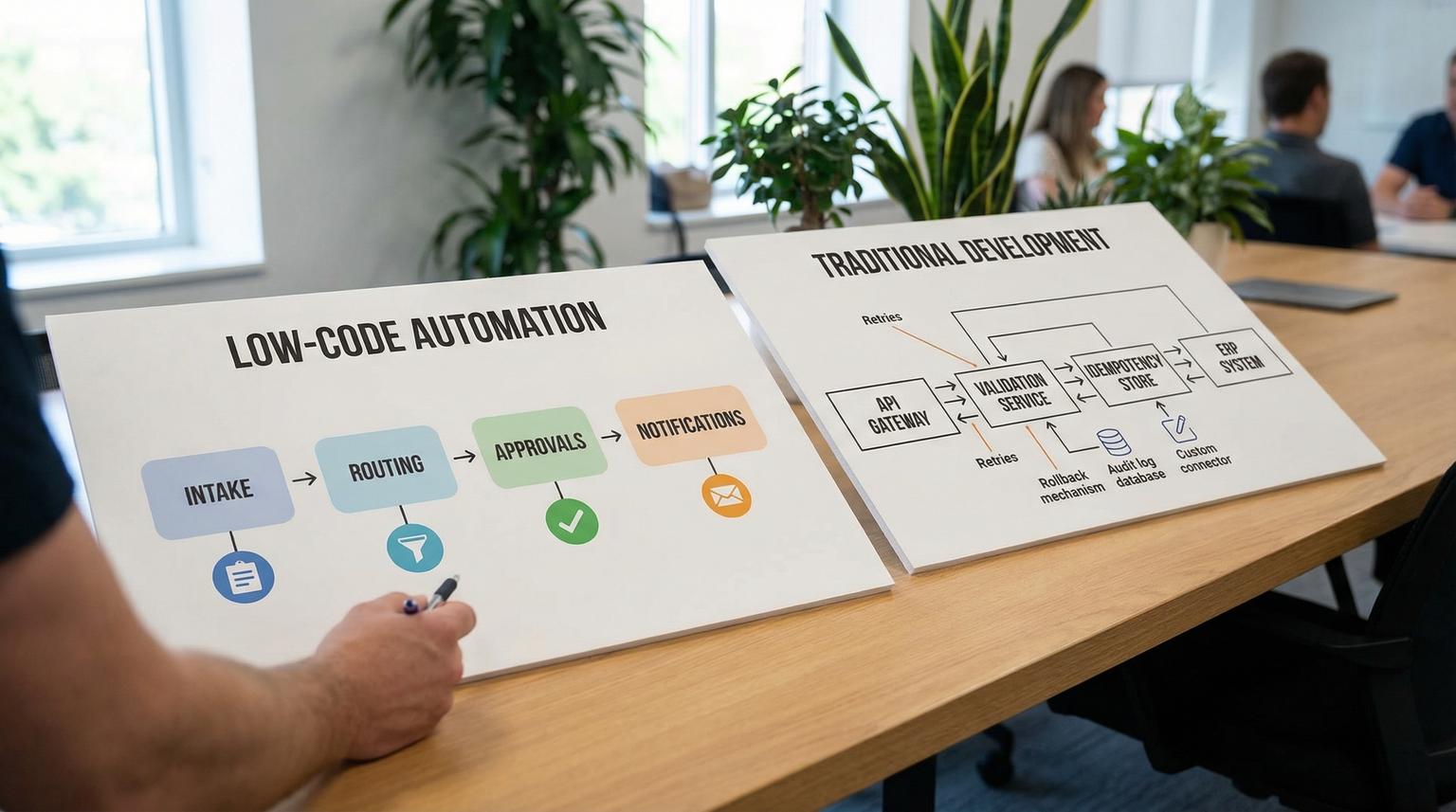
Purchase approvals are one of the fastest places to cut cycle time and one of the easiest places to create audit and security gaps. This article gives ops and finance teams a practical way to decide where low-code automation vs traditional development makes sense inside a procure-to-pay workflow. Instead of debating tools in the abstract, we break the process into stages and map each stage to the build approach that best supports permissions, audit evidence and safe ERP side effects.
Quick summary:
- Use low-code for intake, routing and notifications when you can prove approver eligibility and capture durable business-event logs.
- Use custom code (or code-centric orchestration) at the ERP boundary when retries, idempotency and rollback must be guaranteed.
- For every stage, define audit evidence, segregation of duties and what happens on duplicates, timeouts and partial failures.
- A hybrid design is usually the best outcome: low-code for user experience and orchestration plus pro-code for high-risk integration steps.
Quick start
- List your procure-to-pay stages (intake, validation, routing, approvals, PO creation, receiving match, invoice match, audit reporting).
- For each stage, answer three questions: What is the audit evidence, who is allowed to do it and what happens on duplicates or partial failures.
- Mark the stages that touch your ERP or accounting system as higher risk by default.
- Use the decision matrix below to choose low-code, hybrid or custom code per stage.
- Before go-live, run a failover test: duplicate submission, approver changes mid-flight, API timeout during PO creation and audit export verification.
If you can produce immutable approval evidence, enforce role-based access and segregation of duties and guarantee safe retries at the ERP boundary then low-code is often sufficient for purchase approval routing and visibility. If you cannot guarantee those controls or your ERP integrations need strict idempotency and compensating actions then traditional development is the safer choice for the high-risk steps. Most teams land on a hybrid that keeps user-facing flow low-code while hardening ERP-side effects with custom code.
Why purchase approvals create real tradeoffs
Purchase approvals look like a simple approval chain until you need to prove internal controls. Auditors and finance leaders typically care about three things:
- Authorization and delegated authority: the approver must be eligible for that amount, cost center and category and approvals must happen before the PO or spend commitment.
- Segregation of duties (SoD): the same person should not initiate and approve when policy requires separation and downstream steps like receiving and invoice processing should be separated where needed.
- Audit evidence you can actually retrieve: who did what, when, what changed, what was approved and what the system did as a result.
Internal control guidance for purchasing is explicit about authorization, accountability and separation of duties and you can translate that directly into workflow requirements like approver eligibility checks and evidence retention (purchasing internal control practices).
Low-code tools can deliver speed and visibility but governance is the catch. Many teams end up with shadow workflows that bypass change control and quietly depend on upstream data or APIs. McKinsey describes this as hidden dependencies or "phantom couplings" that break when upstream systems change (low-code governance risks). In procure-to-pay those couplings show up as vendor master updates, GL structure changes and ERP API version changes that can break approvals or post the wrong accounting. For a broader view of how to scale governance while still moving fast, see our guide on low-code solutions for enterprise automation.
Procure-to-pay stages and where risk concentrates
To make the build choice practical, treat procure-to-pay as a chain of business events and system side effects. A typical purchase approval flow includes:
- Intake: requester submits items, amount, vendor, cost center, department, justification and attachments.
- Vendor and GL validation: confirm vendor is active and payment terms are allowed and the GL account and cost center exist and are allowed for the requester.
- Routing: determine approvers based on amount thresholds, category, department and project.
- Approvals: capture decision, timestamp, approver identity and any delegation used.
- PO creation and encumbrance: create PO in ERP and optionally create a budget commitment or encumbrance.
- Receiving match and invoice match: verify goods receipt and match invoice to PO and receipt.
- Audit reporting and retention: exportable log of requests, approvals, changes and system actions.
The risk is not evenly distributed. The most sensitive boundary is where the workflow triggers irreversible actions in your ERP or accounting platform. That is where retries, partial failures and duplicate triggers create real financial and compliance exposure.
Step-by-step decision matrix for low-code vs custom code in purchase approvals
Use this matrix to decide stage by stage. The rule is simple: if you cannot confidently answer audit evidence, permission enforcement and failure behavior then do not keep that stage as a fragile low-code step.

| P2P stage | Auditability requirement | Security and SoD requirement | Integration reliability requirement | Recommended build approach |
|---|---|---|---|---|
| 1) Intake (form, email, Slack, portal) | Record original request payload, attachments hash or reference, submitter identity, timestamp and request ID | Requester identity must be verified and request edits must be tracked | Dedupe on submission ID and handle trigger failures that may not log execution details | Low-code if you persist a business-event log in a database or ERP note field and implement dedupe |
| 2) Vendor validation | Log vendor lookup result and rule applied (active, blocked, bank details present) | Only procurement or finance can override blocked vendors and overrides must be logged | Vendor master API changes and latency must not break approvals silently | Hybrid: low-code orchestration plus a versioned validation service when rules are complex or high risk |
| 3) GL and cost center validation | Log GL, cost center, project and policy rule used and snapshot of chart of accounts version | Prevent requester from selecting restricted accounts and enforce SoD for exception handling | Validation must be deterministic under retries and resilient to reference data drift | Hybrid for most orgs, custom code if policy logic is deep or regulated |
| 4) Routing (who approves) | Log routing decision including thresholds, category and delegation source | Approver eligibility must be enforced (authority limits, cost center ownership) and requesters cannot edit approver list | Routing must be explainable and stable across changes with change control | Low-code if routing rules are stored in a controlled table with approvals for changes |
| 5) Approval capture (approve, reject, request changes) | Immutable record of decision, timestamp, identity, comments and prior state | Strong identity and RBAC, prevent self-approval where policy forbids and support delegated authority with evidence | Must not lose decisions during outages and must prevent double-approval events | Low-code if the platform supports production-grade auditing and export plus an external immutable log when needed |
| 6) PO creation in ERP | Log ERP request, ERP response, PO number and correlation ID and store before and after state | Service account permissions should be least privilege and actions attributable to the request | Idempotency required, safe retries and timeouts and compensating actions if later steps fail | Traditional development or code-centric orchestration for most teams |
| 7) Budget encumbrance or accounting posting | Evidence of what was posted, when and why and linkage to approval and PO | Strict separation between request approval and posting authority | Must be transactional or saga-based with compensations for reversals | Traditional development recommended |
| 8) Notifications and stakeholder updates | Log notification events for traceability (sent to whom and when) | Avoid leaking sensitive vendor or pricing data to broad channels | Retries ok, duplicates should be tolerable and deduped where possible | Low-code |
| 9) Audit export and retention | Centralized, queryable and retained logs with controlled access and export for audit | Only authorized roles can view or export and access is logged | Retention must meet policy and survive workflow edits or platform migrations | Hybrid: low-code logs plus an external store or SIEM when requirements are strict |
Decision rule that prevents most surprises: anything that creates or changes financial commitments in the ERP (PO creation, encumbrance, posting, vendor master updates) should be treated as a reliability engineering problem first and a workflow convenience second. If your low-code platform cannot guarantee idempotent calls and deterministic recovery then isolate those steps behind a small custom service.
Auditability and permissions checklist for each stage
Before you commit to a build approach, run this short checklist per stage. If you answer "no" to any item in a high-risk stage, move it to hybrid or custom code.
- Audit evidence: Can we export who did what and when including before and after values for key fields (amount, vendor, GL, cost center, approver)?
- Immutability: Are approvals stored as append-only events or can someone edit history without leaving a trace?
- SoD enforcement: Can the system prevent self-approval and enforce exception handling by a different role?
- Delegated authority: Do we store the delegation source and effective authority at time of approval (not just current org chart)?
- Change control: Are routing rules and approval thresholds updated through a controlled process with review and rollback?
- Data residency and retention: Are logs stored in the right region and retained for the required duration?
- Access controls: Who can view requests, attachments and vendor banking details and is access logged?
If you are using a platform with environment-level auditing, confirm production auditing is enabled and accessible to the right reviewers. Some low-code audit features are production-only and need explicit configuration and prerequisites like allowlisting domains and setting table or column auditing (activity logging and auditing overview). If you want a more comprehensive, phased way to map, standardize, and govern these workflows, use our pillar guide: business process automation playbook.
Reliability patterns that decide the ERP boundary
Most approval delays come from human steps. Most compliance and rework pain comes from system steps that misbehave under retries and partial failures. Three patterns matter for purchase approvals:
1) Idempotency keys for duplicate triggers
Duplicate submissions happen more than teams expect: a user double-clicks submit, an email is forwarded twice or a webhook is retried by a gateway. You want the second event to return the original result not create a second PO. Use an idempotency key like request_id and store it on the ERP side if possible.
2) Saga-style orchestration for cross-system rollback
If your flow has multiple side effects (create PO then encumber budget then send confirmation) you need a plan for partial failure. A saga orchestrator runs steps and if a later step fails it triggers compensating actions, for example cancel PO or reverse encumbrance. This is a strong reason to use traditional development or a code-centric orchestrator for the ERP segment (saga orchestration pattern).
3) Structured error workflows and incident evidence
Low-code can be reliable when you treat failures as first-class events. In n8n for example you can route any failed execution into an error workflow using an Error Trigger and capture execution metadata for investigation (n8n error handling). That is useful for operations but it is not automatically an audit log of business approvals. You still need to persist business events in a durable store. For a concrete comparison of workflow tools and how they handle branching, retries, and error handling, see our n8n vs Zapier vs Make comparison.
Here is a compact example of what you should capture for incident evidence when an approval workflow fails, adapted from typical workflow execution metadata:
[{
"requestId":"PR-10482",
"stage":"po_create",
"execution":{
"id":"231",
"retryOf":"34",
"lastNodeExecuted":"ERP Create PO",
"errorMessage":"Timeout calling ERP API"
},
"occurredAt":"2026-03-29T14:22:10Z"
}]

A real-world implementation insight: the hardest bugs we see in purchase approvals are not in the approval UI. They show up when an ERP call times out after the ERP already created the PO. The workflow retries, creates a duplicate PO and finance finds it during invoice matching. Idempotency keys plus a read-before-create check prevents this class of incident.
Common failure modes and how to prevent them
- Silent rule drift in routing: someone changes approval thresholds in a spreadsheet and the workflow is updated without review. Mitigation: store rules in a controlled table, require approval for changes and log the rule version used for each request.
- Self-approval loopholes: routing logic falls back to the requester when manager data is missing. Mitigation: fail closed using a controlled error state and require an alternate approver assignment by a separate role.
- Non-auditable edits: requester edits amount or vendor after approval but before PO creation. Mitigation: lock key fields after approval or require re-approval and record a before and after diff in the audit log.
- Phantom couplings to vendor master or GL data: vendor status or GL structure changes and the workflow breaks late. Mitigation: validate early, cache reference snapshots per request and monitor integration contracts with versioning.
- Duplicate POs from retries: timeouts and replays create multiple ERP side effects. Mitigation: idempotency keys, correlation IDs and compensating actions.
Operating model that keeps low-code compliant
The tool choice is only half the decision. The operating model decides whether you end up with a governed automation program or brittle shadow IT.
- Define owners: finance owns approval policy and evidence needs, ops owns cycle time and exception handling and IT or security owns identity, access and data residency.
- Separate environments: dev and test are not your audit trail. Production must have auditing enabled, retention configured and access reviewed periodically.
- Change control for rules: treat routing thresholds, delegation tables and GL restrictions as controlled configuration with approvals and rollback, not as ad-hoc edits.
- Monitoring: alert on stuck approvals, repeated failures at the ERP step and unusual patterns like frequent overrides of blocked vendors.
One common mistake is assuming the workflow platform execution history is sufficient for audit. Execution logs are helpful for debugging but audits typically need durable business-event logs with clear semantics: submitted, validated, approved by X under delegation Y, PO created with number Z. Build that event log intentionally.
When to choose traditional development and when low-code is enough
Not every team needs custom development for every stage. Use these practical cut lines:
Low-code is usually enough when
- The step is primarily orchestration, notifications or human decision capture.
- You can enforce identity, RBAC and SoD using your existing SSO and directory groups.
- You can produce exportable audit evidence for approvals and key field changes.
- Failures are safe to retry because they do not create irreversible side effects.
Traditional development is safer when
- The step creates financial commitments in an ERP or posts to accounting ledgers.
- You need guaranteed idempotency, transactional integrity or compensating actions across systems.
- Regulatory or contractual requirements demand strict data residency, long retention or immutable logs that your low-code platform cannot meet without externalization.
- Your integration surface is complex (custom ERP objects, strict rate limits, complex error semantics) and you cannot tolerate ambiguous failures.
When this approach is not the best fit: if your ERP already includes a robust approval and audit module that meets your control requirements, rebuilding the same controls externally can add risk. In that case, focus on improving upstream intake quality and exception handling while letting the ERP remain the system of record for approvals and posting.
Primary CTA: If you want a stage-by-stage recommendation for your exact ERP, approval limits and audit requirements, book a consultation and we will map your workflow to a low-code, hybrid or pro-code build plan you can execute safely. Book a consultation
For teams that want examples of the kinds of integrations we build across workflows, CRMs and APIs, you can review our prior automation work here: ThinkBot Agency portfolio
FAQ
Common follow-ups we hear from ops and finance teams building compliant purchase approvals.
Can low-code tools meet audit requirements for purchase approvals?
Yes if you configure production-grade auditing, restrict access and store an exportable business-event log that captures who approved what, when and what changed. If you cannot guarantee retention, immutability or access controls you should externalize the audit log or use custom development for the sensitive steps.
What is the minimum audit evidence to keep for approvals?
At minimum keep the request ID, requester identity, approval decision, approver identity, timestamp, approval limits or delegation used, key field values (amount, vendor, GL, cost center) and a record of any edits with before and after values. You also want correlation IDs that link approvals to PO creation and posting events.
Where should idempotency be implemented in procure-to-pay automations?
Implement idempotency anywhere a retry could create duplicates, especially during PO creation, encumbrance and posting. Use a stable idempotency key per request, store it with the ERP record when possible and make the integration return the existing result on replay.
How do we enforce segregation of duties in an automated approval workflow?
Encode SoD rules into routing and approval eligibility checks so a requester cannot approve their own request when policy forbids it. Separate exception handling from initiation and approval by assigning overrides to procurement or finance roles and record override evidence as part of the audit log.
